
.jpg)
Betty Kilonzo: ‘I want readers to see the mess, the mistakes, the urgency’
TITLE: Househelp Manual for the Middle Class
AUTHOR: Betty Kilonzo
PUBLISHER: Mvua Press
AVAILABILITY: shop.ekitabu.com/hhm
PRICE: Ksh 800
In Kenya’s contemporary literary space, a new generation of writers is emerging—bold, self-aware, digitally fluent, and unafraid to experiment with form. Among them is Betty Kilonzo: an author, editor, mother, and storyteller whose work spans poetry and prose, self-publishing and traditional publishing.
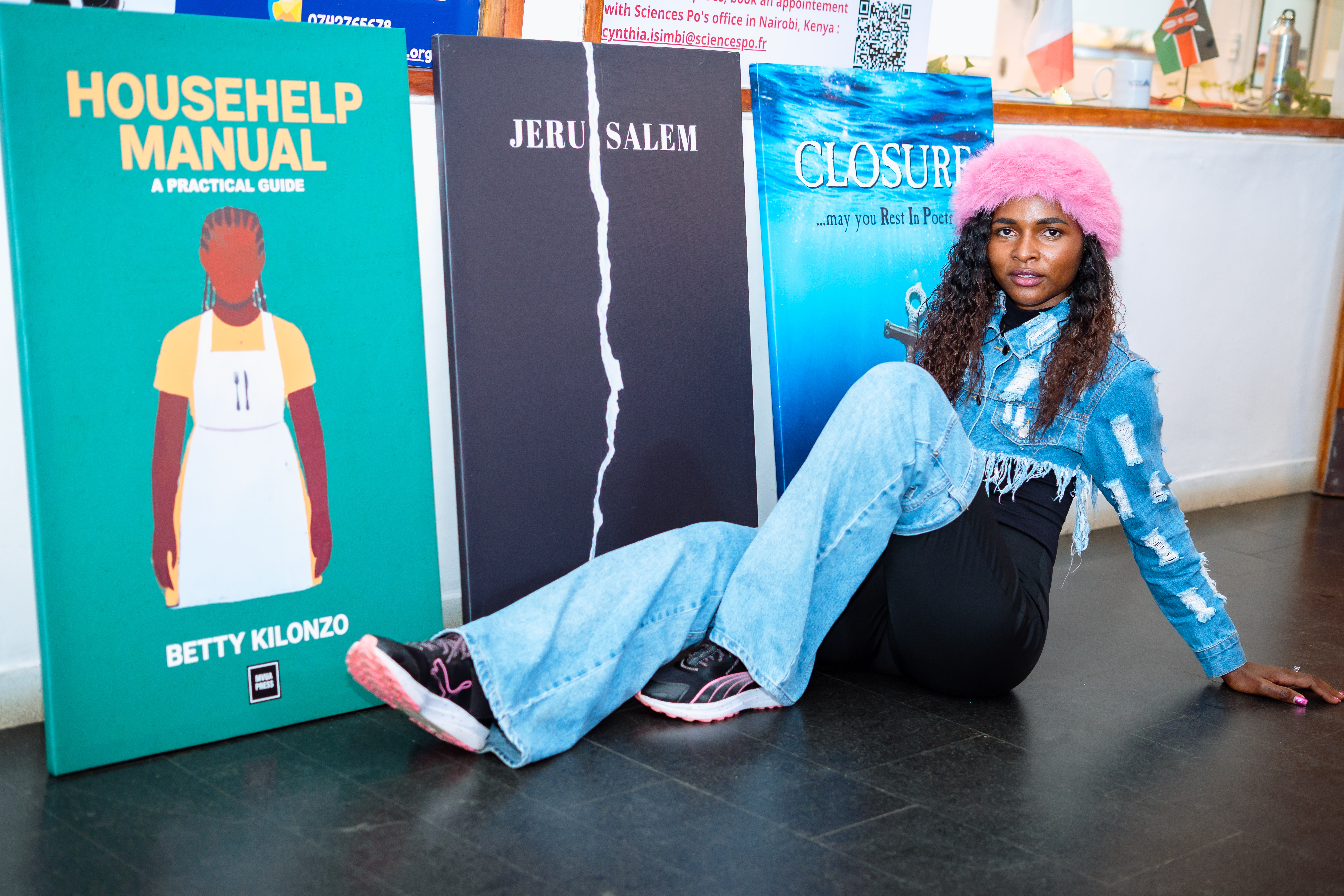
Kilonzo’s catalogue includes Closure, a raw and emotionally charged work that cemented her presence in the literary scene; Jerusalem, a poetry collection that incorporates AI-assisted interpretation; and Househelp Manual, a practical guide for domestic workers published by Mvua Press.
In this conversation with Books in Africa host Tracy Ochieng, Kilonzo speaks candidly about beginning as a 12-year-old memoirist, learning the business of publishing through mentorship, protecting parts of her private life in the age of social media, and why she believes “writer’s block” is often just fear disguised as creative paralysis.
How would you define yourself beyond the titles of “author” and “editor”? Who is Betty Kilonzo?
I’m a writer, a mother, and an editor, but more than that, I’m someone who pays attention. I’m drawn to the ordinary because I don’t think it’s ordinary at all. Life is dramatic, tender, absurd, and instructive, and I’ve always felt it deserves to be documented.
Storytelling is how I make sense of things. It’s also how I make myself visible in the world: not by performing, but by observing, remembering, and writing it down.
What has shaped your reading life this year? Are there particular books or writers influencing you?
I’ve just finished Flesh by a Hungarian author and even the difficulty of pronouncing his name reminds me of something I’ve always found funny about reading: sometimes you learn a writer’s world in silence. You meet a name on a page before you ever hear it spoken. That’s one of the private joys of reading. It stretches you not just emotionally, but linguistically, culturally.
You wrote an autobiography at twelve. What kind of inner world leads a child to document her life so early?
I started very young. My first complete book was an autobiography when I was twelve. And honestly, I even felt like I’d lived a full life much earlier than that. I was the kind of child who was already trying to put meaning to experience, already trying to hold things in place.
When I look back, I think it came from feeling unseen. Being a middle child can do that to you— you start searching for a voice, a way to say: I exist, and what I experience matters. Writing became that.
Later, when I reread that first book, it felt like too much, too raw, too exposed, so I “banned” it. But banning it didn’t stop the instinct. It just taught me that writing has power, and sometimes even the writer needs time before they can face what they’ve written.
In high school, your handwritten stories circulated widely. What did that early audience teach you about storytelling and readership?
High school cemented me because I used to write handwritten romance and fantasy stories in exercise books— little novels, really and they would circulate around the school.
That taught me two things early: that people are hungry for stories, and that writing creates community. Even in a strict environment where dating had to be kept quiet, stories became the place where we could explore what we couldn’t openly discuss. I didn’t have sophisticated titles, one was literally called Teenage Romance, but the appetite and readership was real.
You’ve experienced both self-publishing and traditional publishing. How did the Mvua Press journey differ from navigating the process independently?
In 2022, I co-authored a poetry book, This Heart of Mine, with Scholastica Moraa and she changed everything for me. She taught me the mechanics: ISBNs, editors, printers, the whole infrastructure that most people don’t talk about when they romanticise writing.
People think writing is the hard part. Writing is hard, yes, but publishing is its own world. There are so many writers who write brilliantly in private. But authorship requires stepping into logistics, money, negotiation, decision-making. It’s intimidating when nobody holds your hand.
Moraa held my hand. We fought over cover designs, we struggled with costs, but she gave me confidence. She made the idea of “author” feel possible, not mythical.
Jerusalem incorporates AI-assisted interpretation. What prompted you to experiment with technology in a genre as intimate as poetry?
I downloaded ChatGPT as a joke as I didn’t take it seriously at first. I asked silly questions. But the more I used it, the more I realised it was learning my preferences and responding in ways that felt surprisingly personal.
At the same time, I was writing Jerusalem and I needed feedback. Not everyone has access to readers or mentors who can sit with your work and tell you honestly if it holds. So I shared one poem with ChatGPT that I even named Lexie and I asked what it thought.
The response was unsettling in the best way because it understood what I meant. It broke down the poem the way I intended. That’s when I thought about the “poetry is too hard to understand” excuse that people give to avoid poetry. So, I decided to include short explanations after each poem not as the final meaning, but as a guide. The poems are mine but the explanations are AI-assisted. It’s a way of meeting hesitant readers halfway.
It was also a social experiment: if poetry is made accessible, will people read it or will they admit they simply don’t like poetry?
Closure feels deliberately raw. Why was preserving imperfection important to you at that stage of your career?
Closure introduced me properly, not as somebody’s co-author, not as an emerging name standing beside a bigger name, but as myself. Closure is the book that told people: this is Betty, and this is what she does. And it had to be raw. As an editor, I can look back and see where it could be refined. But as an artist, I know that refinement would have betrayed the point. The relationship I was writing about was not neat nor were the emotions. So why should the book pretend?
I actually had an edited version and it cut out too much. I discarded it and published what felt like the raw draft. That was the honesty of that moment. I wanted readers to see the mess, the mistakes, the urgency. Not a “clean” version that makes the story and the characters look composed.
One day I’ll write technically stronger books and I believe I will be a bestseller, not just in Kenya but a global bestseller. But I also want to be able to look back at Closure the way you look at an old photo of yourself before you made it. Proof of the journey and where you started.
Did engaging with AI challenge your confidence as a writer, or did it reinforce your authorship in new ways?
AI doesn’t create art but it can support the process. We’ve used “AI” in everyday tools for years: AutoCorrect, Grammarly, layout tools, design software features. Technology exists to enhance us, not replace us.
The danger is misuse. Don’t outsource your imagination. Don’t ask AI to be your voice. But use it to interrogate your work, refine, organise, and expand ideas like you would use a tool.
You share openly online, yet you are deliberate about boundaries. What aspects of your life remain non-negotiable in terms of privacy?
I protect my son, although I also accept that I cannot completely protect him from visibility if I’m going to be public. What I can do is cushion him and teach him how to handle the world he’s growing into.
The other things I protect are my relationships and my family. People can be strange online. Sometimes you share joy and you attract people who want to disrupt it by bringing “receipts”, to shame you or expose you. So for me, the question is always: why am I sharing this? If what I’m sharing won’t help anyone, if it won’t speak to someone’s life in a meaningful way, then it doesn’t need to be public. I’m open, but I’m not careless.
How distinct is your digital persona from your lived reality? Where do the two intersect and where do they diverge?
Very separate. People think my life is dramatic because the stories are dramatic, but the truth is, my everyday life is quite simple. The “eventful” part is not that I’m always chasing chaos; it’s that I’m always noticing what’s happening around me. And I don’t perform writing in front of people. You can sit with me and never see me write. But later, you’ll hear your phone ping: Betty Kilonzo just posted. I keep “Betty the writer” in a private space. When I need to go deep, that’s why I have an office. But when I’m with people, I don’t like to separate myself from them by constantly announcing that I’m writing.
Many writers speak of creative paralysis. Do you believe in writer’s block or is it something else entirely?
I don’t think I’ve truly experienced writer’s block. I think I’ve experienced laziness, procrastination, and fear.
If I can’t write my “serious project”, I can still write long posts on Facebook any day, any time. So what does that mean? It means I’m not blocked, I might just be pressured. On Facebook I’m free, if I’m not trying to be perfect. I’m not being judged the same way in my head.
Writer’s block is often your inner editor shouting while the writer is still trying to speak. The solution is to stop filtering yourself. Write it badly first, write the truth then edit later.
Any story worth writing is worth writing badly.
Featured Book
%20(1).jpg)
Related Book
Get to know more about the mentioned books
Related Article

Betty Kilonzo: ‘I want readers to see the mess, the mistakes, the urgency’
By
TITLE: Househelp Manual for the Middle Class
AUTHOR: Betty Kilonzo
PUBLISHER: Mvua Press
AVAILABILITY: shop.ekitabu.com/hhm
PRICE: Ksh 800
In Kenya’s contemporary literary space, a new generation of writers is emerging—bold, self-aware, digitally fluent, and unafraid to experiment with form. Among them is Betty Kilonzo: an author, editor, mother, and storyteller whose work spans poetry and prose, self-publishing and traditional publishing.
Kilonzo’s catalogue includes Closure, a raw and emotionally charged work that cemented her presence in the literary scene; Jerusalem, a poetry collection that incorporates AI-assisted interpretation; and Househelp Manual, a practical guide for domestic workers published by Mvua Press.
In this conversation with Books in Africa host Tracy Ochieng, Kilonzo speaks candidly about beginning as a 12-year-old memoirist, learning the business of publishing through mentorship, protecting parts of her private life in the age of social media, and why she believes “writer’s block” is often just fear disguised as creative paralysis.
How would you define yourself beyond the titles of “author” and “editor”? Who is Betty Kilonzo?
I’m a writer, a mother, and an editor, but more than that, I’m someone who pays attention. I’m drawn to the ordinary because I don’t think it’s ordinary at all. Life is dramatic, tender, absurd, and instructive, and I’ve always felt it deserves to be documented.
Storytelling is how I make sense of things. It’s also how I make myself visible in the world: not by performing, but by observing, remembering, and writing it down.
What has shaped your reading life this year? Are there particular books or writers influencing you?
I’ve just finished Flesh by a Hungarian author and even the difficulty of pronouncing his name reminds me of something I’ve always found funny about reading: sometimes you learn a writer’s world in silence. You meet a name on a page before you ever hear it spoken. That’s one of the private joys of reading. It stretches you not just emotionally, but linguistically, culturally.
You wrote an autobiography at twelve. What kind of inner world leads a child to document her life so early?
I started very young. My first complete book was an autobiography when I was twelve. And honestly, I even felt like I’d lived a full life much earlier than that. I was the kind of child who was already trying to put meaning to experience, already trying to hold things in place.
When I look back, I think it came from feeling unseen. Being a middle child can do that to you— you start searching for a voice, a way to say: I exist, and what I experience matters. Writing became that.
Later, when I reread that first book, it felt like too much, too raw, too exposed, so I “banned” it. But banning it didn’t stop the instinct. It just taught me that writing has power, and sometimes even the writer needs time before they can face what they’ve written.
In high school, your handwritten stories circulated widely. What did that early audience teach you about storytelling and readership?
High school cemented me because I used to write handwritten romance and fantasy stories in exercise books— little novels, really and they would circulate around the school.
That taught me two things early: that people are hungry for stories, and that writing creates community. Even in a strict environment where dating had to be kept quiet, stories became the place where we could explore what we couldn’t openly discuss. I didn’t have sophisticated titles, one was literally called Teenage Romance, but the appetite and readership was real.
You’ve experienced both self-publishing and traditional publishing. How did the Mvua Press journey differ from navigating the process independently?
In 2022, I co-authored a poetry book, This Heart of Mine, with Scholastica Moraa and she changed everything for me. She taught me the mechanics: ISBNs, editors, printers, the whole infrastructure that most people don’t talk about when they romanticise writing.
People think writing is the hard part. Writing is hard, yes, but publishing is its own world. There are so many writers who write brilliantly in private. But authorship requires stepping into logistics, money, negotiation, decision-making. It’s intimidating when nobody holds your hand.
Moraa held my hand. We fought over cover designs, we struggled with costs, but she gave me confidence. She made the idea of “author” feel possible, not mythical.
Jerusalem incorporates AI-assisted interpretation. What prompted you to experiment with technology in a genre as intimate as poetry?
I downloaded ChatGPT as a joke as I didn’t take it seriously at first. I asked silly questions. But the more I used it, the more I realised it was learning my preferences and responding in ways that felt surprisingly personal.
At the same time, I was writing Jerusalem and I needed feedback. Not everyone has access to readers or mentors who can sit with your work and tell you honestly if it holds. So I shared one poem with ChatGPT that I even named Lexie and I asked what it thought.
The response was unsettling in the best way because it understood what I meant. It broke down the poem the way I intended. That’s when I thought about the “poetry is too hard to understand” excuse that people give to avoid poetry. So, I decided to include short explanations after each poem not as the final meaning, but as a guide. The poems are mine but the explanations are AI-assisted. It’s a way of meeting hesitant readers halfway.
It was also a social experiment: if poetry is made accessible, will people read it or will they admit they simply don’t like poetry?
Closure feels deliberately raw. Why was preserving imperfection important to you at that stage of your career?
Closure introduced me properly, not as somebody’s co-author, not as an emerging name standing beside a bigger name, but as myself. Closure is the book that told people: this is Betty, and this is what she does. And it had to be raw. As an editor, I can look back and see where it could be refined. But as an artist, I know that refinement would have betrayed the point. The relationship I was writing about was not neat nor were the emotions. So why should the book pretend?
I actually had an edited version and it cut out too much. I discarded it and published what felt like the raw draft. That was the honesty of that moment. I wanted readers to see the mess, the mistakes, the urgency. Not a “clean” version that makes the story and the characters look composed.
One day I’ll write technically stronger books and I believe I will be a bestseller, not just in Kenya but a global bestseller. But I also want to be able to look back at Closure the way you look at an old photo of yourself before you made it. Proof of the journey and where you started.
Did engaging with AI challenge your confidence as a writer, or did it reinforce your authorship in new ways?
AI doesn’t create art but it can support the process. We’ve used “AI” in everyday tools for years: AutoCorrect, Grammarly, layout tools, design software features. Technology exists to enhance us, not replace us.
The danger is misuse. Don’t outsource your imagination. Don’t ask AI to be your voice. But use it to interrogate your work, refine, organise, and expand ideas like you would use a tool.
You share openly online, yet you are deliberate about boundaries. What aspects of your life remain non-negotiable in terms of privacy?
I protect my son, although I also accept that I cannot completely protect him from visibility if I’m going to be public. What I can do is cushion him and teach him how to handle the world he’s growing into.
The other things I protect are my relationships and my family. People can be strange online. Sometimes you share joy and you attract people who want to disrupt it by bringing “receipts”, to shame you or expose you. So for me, the question is always: why am I sharing this? If what I’m sharing won’t help anyone, if it won’t speak to someone’s life in a meaningful way, then it doesn’t need to be public. I’m open, but I’m not careless.
How distinct is your digital persona from your lived reality? Where do the two intersect and where do they diverge?
Very separate. People think my life is dramatic because the stories are dramatic, but the truth is, my everyday life is quite simple. The “eventful” part is not that I’m always chasing chaos; it’s that I’m always noticing what’s happening around me. And I don’t perform writing in front of people. You can sit with me and never see me write. But later, you’ll hear your phone ping: Betty Kilonzo just posted. I keep “Betty the writer” in a private space. When I need to go deep, that’s why I have an office. But when I’m with people, I don’t like to separate myself from them by constantly announcing that I’m writing.
Many writers speak of creative paralysis. Do you believe in writer’s block or is it something else entirely?
I don’t think I’ve truly experienced writer’s block. I think I’ve experienced laziness, procrastination, and fear.
If I can’t write my “serious project”, I can still write long posts on Facebook any day, any time. So what does that mean? It means I’m not blocked, I might just be pressured. On Facebook I’m free, if I’m not trying to be perfect. I’m not being judged the same way in my head.
Writer’s block is often your inner editor shouting while the writer is still trying to speak. The solution is to stop filtering yourself. Write it badly first, write the truth then edit later.
Any story worth writing is worth writing badly.
Share :


Lorem ipsum dolor sit amet, consectetur adipiscing elit. Suspendisse varius enim in eros elementum tristique. Duis cursus, mi quis viverra ornare, eros dolor interdum nulla, ut commodo diam libero vitae erat. Aenean faucibus nibh et justo cursus id rutrum lorem imperdiet. Nunc ut sem vitae risus tristique posuere.
Lorem ipsum dolor sit amet, consectetur adipiscing elit. Suspendisse varius enim in eros elementum tristique. Duis cursus, mi quis viverra ornare, eros dolor interdum nulla, ut commodo diam libero vitae erat. Aenean faucibus nibh et justo cursus id rutrum lorem imperdiet. Nunc ut sem vitae risus tristique posuere.