
.jpg)
East African Comic Artists Draw New Worlds — and New Possibilities for the Industry
“If you wanna see the next generation of comic readers and artists, you must think about the kids,” says Nicolas Grivel, a French comic editor and literary agent.
For Grivel, the future of comics depends not only on the artists creating stories today, but also on the young readers who will grow up with them. The characters and worlds encountered in childhood can stay with readers for decades, becoming a part of their memories and shaping their relationship with storytelling.
It is a perspective that resonates with the first East African Comic Competition (EACC), which is creating opportunities for emerging artists to develop their work, find audiences and imagine new possibilities for the region’s comics industry.
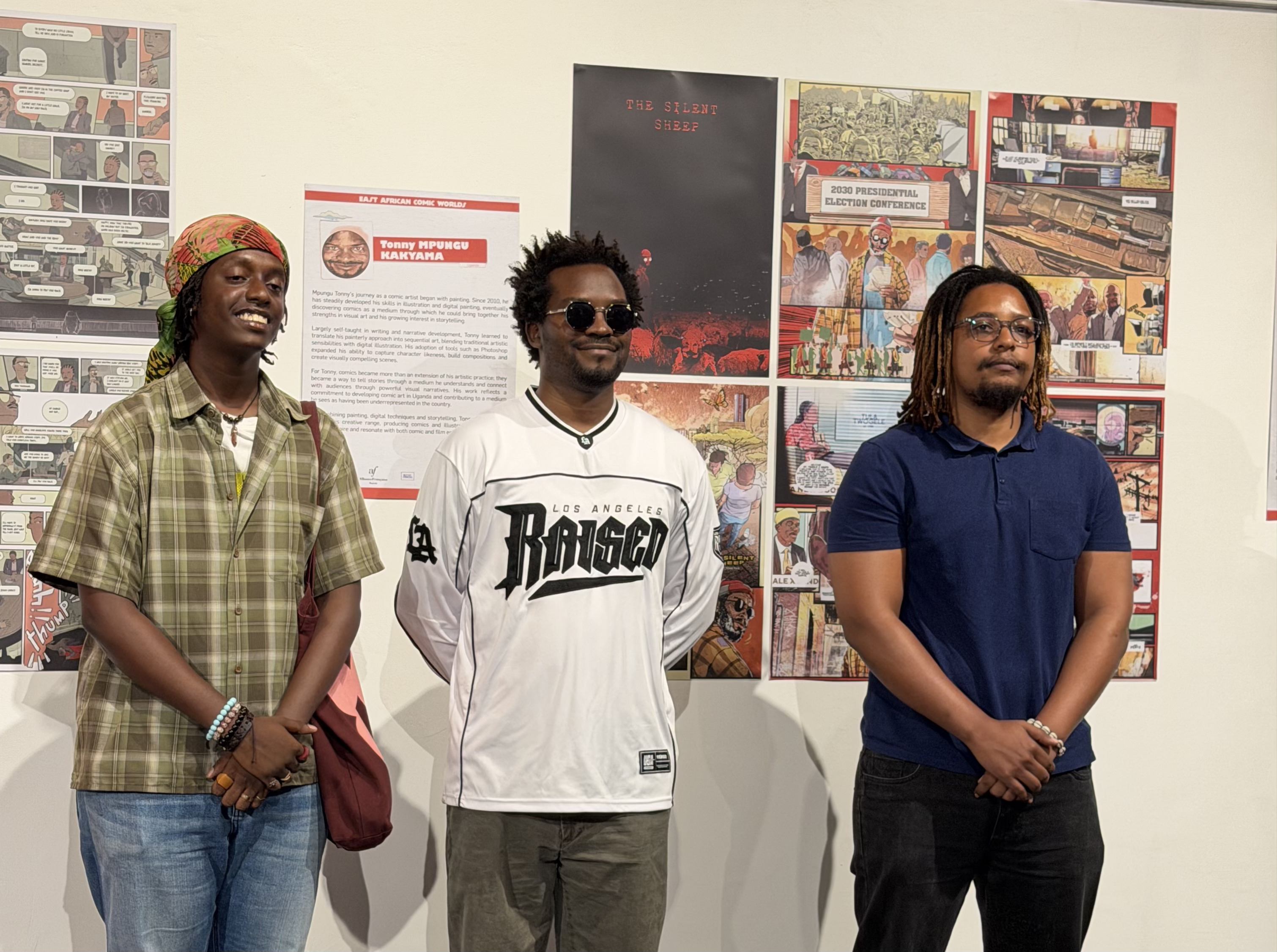
Held under the theme “Inhabiting the World”, the competition attracted 81 submissions from young artists across East Africa. An international jury selected 10 finalists from Kenya, Uganda, Tanzania, Ethiopia and Rwanda, whose work was showcased at the Inhabiting the World exhibition, which opened in Nairobi on 6 October at Alliance Française de Nairobi.
For the artists, the exhibition offers more than a chance to display their work. It is a chance to be recognised in an industry where creative talent does not always translate into access to publishers, readers and sustainable careers.
“Talent is everywhere, but access to publishers is not,” says Olivia Deroint, Director of Alliance Française de Nairobi. The competition was conceived as a platform for discovery and regional cooperation. Over nine months, it brought together artists from across the region, with workshops designed to support their development. The 10 finalists also spent three days in Nairobi, creating opportunities for engagement and exchange.
The initiative reflects a broader ambition: to create the conditions for African artists to emerge and flourish, with their stories reaching readers beyond the spaces in which they are first encountered.
A win that opens doors
For Ivan Ishimwe, one of the competition’s winners, the recognition came as a surprise.
“I am very happy and surprised,” he says. “I wrote the comic book with my friend, who was unable to be here, but he’ll be very happy.”
Beyond the personal achievement, Ishimwe sees the award as an indication of what might be possible for other aspiring comic creators.
“Winning this shows that the industry has room to grow and will give children hope who wanna get into the comic industry,” he says.
His remarks return the conversation to Grivel’s point about young readers and the next generation of artists. Children need stories that speak to their experiences, but they also need to see that creating those stories can be a viable pursuit.
Recognition can help make that possibility visible. When young artists see others producing comics, entering competitions and receiving awards, they encounter a creative pathway they might not previously have imagined for themselves.
For Ishimwe, the significance of the win also extends to his collaborator, whose contribution to the comic was part of the achievement. It is a reminder that creative work can be collaborative, with recognition reaching beyond the individual artist standing on the stage.
Making space for a new generation
For Ethiopian artist Bezawit, pursuing an artistic career has required a decisive commitment.
“I quit my job to fully focus on art,” she says.
Her decision reflects the seriousness with which she approaches her practice. For emerging artists, however, the challenge extends beyond developing their craft. Finding opportunities to exhibit, publish and sustain their work remains an important part of building a career.
Recognition through competitions such as the EACC can help bring these artists into view, connecting their work with audiences and industry professionals who might otherwise never encounter it.
For Mieraf, another Ethiopian artist, navigating the creative industry also comes with questions about gender and perception. She says people frequently assume she is a man when they encounter her work online, despite the information on her Instagram profile identifying her as a woman.
“It kind of bothers me,” she says, explaining that about 90 out of 100 people assume she is male. She often lets the assumption pass until she meets people in person, rather than dwelling on it. Her experience raises questions about how audiences imagine the people behind the work they encounter, and how gender can shape perceptions of artistic identity.
Together, the experiences of Bezawit and Mieraf offer a glimpse into the different realities facing women pursuing creative careers. One speaks to the commitment required to prioritise art; the other highlights the assumptions that can follow women into creative spaces.
Their perspectives also underscore why creating opportunities for artists to exhibit and publish their work matters. Visibility is not simply about putting art on a wall. It is about allowing creators to be encountered, recognised and taken seriously on their own terms.
Telling local stories that travel
The question of how stories move beyond their place of origin was also central to Grivel’s contribution to the exhibition programme.
“Be self-confident about your culture and where you come from if you want to see your stories travel.” His advice is to begin with what they know rather than attempting to make their work conform to an imagined international audience.
Manga offers one example of how stories rooted in a particular cultural context can find readers around the world. Their international reach demonstrates that cultural specificity need not be a barrier to wider appeal. For Grivel, the connection lies in emotion. A story may emerge from a particular place, culture or experience, but the feelings it explores can resonate with readers elsewhere.
Artists who want their stories to travel, therefore, do not necessarily need to leave their cultural identities behind. Instead, they can draw on the details, experiences and perspectives that make their work distinctive while allowing readers to connect with its emotional core.
His observations offer a useful lens through which to consider the work presented at Inhabiting the World. The participating artists come from different countries and creative backgrounds, yet the competition brings them together around a shared question: how do we understand the worlds we inhabit, and how might we represent them to others?
The answers are not singular. Comics offer artists the freedom to combine words and images, experiment with form and approach familiar experiences from unexpected perspectives.
For East African creators, this presents an opportunity to tell stories grounded in their own contexts while contributing to a wider conversation about what comics can be and whose experiences they can represent.
From the gallery to the reader
The exhibition is also part of a broader journey towards getting the work into readers’ hands.
eKitabu published the EPUB edition of the comic, extending the work beyond the physical exhibition and into a digital format. Its involvement connects the competition’s emphasis on discovering artists with the practical question of how their work can be published and circulated.
For eKitabu CEO Will Clurman, the stories selected for the competition share a common thread.
“All the stories that were selected here were stories of change,” he says.
His observation offers another way of interpreting the exhibition. The artists are not merely documenting the worlds around them; they are exploring how those worlds shift, how people respond to change and how new possibilities emerge.
Publishing the work digitally provides another route through which these perspectives can reach audiences. It also places the competition within a wider conversation about the role of digital publishing in expanding access to African stories.
The journey from an artist’s idea to a published comic involves more than the act of creation. It requires opportunities for development, platforms for visibility and ways of connecting finished work with readers. The EACC brings these elements together through its competition, workshops, exhibition and publication.
Drawing the future of East African comics
For the competition, nurturing young readers is essential to ensuring that comics continue to inspire future generations. For Ishimwe, recognition offers hope to children who want to enter the industry. For the artists whose work has been selected, the exhibition provides a platform from which to share their visions with a wider audience.
These perspectives converge on a common question: what might East African comics look like if more artists had the support, publishing opportunities and audiences they need to develop their work?
The first East African Comic Competition offers one response by bringing artists from across the region into a shared space for discovery and collaboration.
As the Inhabiting the World exhibition introduces audiences to these 10 finalists, it also invites them to consider the stories being told, the experiences represented and the possibilities that open up when emerging artists are given room to create.
The next generation of comic readers may be children, as Grivel suggests. But the next generation of comic artists needs something, too: the opportunity to imagine, draw, publish and share the worlds they know.
Tracy Ochieng is a staff writer with Books in Africa. Tracy.Ochieng@ekitabu.com.
Featured Book
%20(1).jpg)
Related Book
Get to know more about the mentioned books
Related Article
East African Comic Artists Draw New Worlds — and New Possibilities for the Industry
By
“If you wanna see the next generation of comic readers and artists, you must think about the kids,” says Nicolas Grivel, a French comic editor and literary agent.
For Grivel, the future of comics depends not only on the artists creating stories today, but also on the young readers who will grow up with them. The characters and worlds encountered in childhood can stay with readers for decades, becoming a part of their memories and shaping their relationship with storytelling.
It is a perspective that resonates with the first East African Comic Competition (EACC), which is creating opportunities for emerging artists to develop their work, find audiences and imagine new possibilities for the region’s comics industry.
Held under the theme “Inhabiting the World”, the competition attracted 81 submissions from young artists across East Africa. An international jury selected 10 finalists from Kenya, Uganda, Tanzania, Ethiopia and Rwanda, whose work was showcased at the Inhabiting the World exhibition, which opened in Nairobi on 6 October at Alliance Française de Nairobi.
For the artists, the exhibition offers more than a chance to display their work. It is a chance to be recognised in an industry where creative talent does not always translate into access to publishers, readers and sustainable careers.
“Talent is everywhere, but access to publishers is not,” says Olivia Deroint, Director of Alliance Française de Nairobi. The competition was conceived as a platform for discovery and regional cooperation. Over nine months, it brought together artists from across the region, with workshops designed to support their development. The 10 finalists also spent three days in Nairobi, creating opportunities for engagement and exchange.
The initiative reflects a broader ambition: to create the conditions for African artists to emerge and flourish, with their stories reaching readers beyond the spaces in which they are first encountered.
A win that opens doors
For Ivan Ishimwe, one of the competition’s winners, the recognition came as a surprise.
“I am very happy and surprised,” he says. “I wrote the comic book with my friend, who was unable to be here, but he’ll be very happy.”
Beyond the personal achievement, Ishimwe sees the award as an indication of what might be possible for other aspiring comic creators.
“Winning this shows that the industry has room to grow and will give children hope who wanna get into the comic industry,” he says.
His remarks return the conversation to Grivel’s point about young readers and the next generation of artists. Children need stories that speak to their experiences, but they also need to see that creating those stories can be a viable pursuit.
Recognition can help make that possibility visible. When young artists see others producing comics, entering competitions and receiving awards, they encounter a creative pathway they might not previously have imagined for themselves.
For Ishimwe, the significance of the win also extends to his collaborator, whose contribution to the comic was part of the achievement. It is a reminder that creative work can be collaborative, with recognition reaching beyond the individual artist standing on the stage.
Making space for a new generation
For Ethiopian artist Bezawit, pursuing an artistic career has required a decisive commitment.
“I quit my job to fully focus on art,” she says.
Her decision reflects the seriousness with which she approaches her practice. For emerging artists, however, the challenge extends beyond developing their craft. Finding opportunities to exhibit, publish and sustain their work remains an important part of building a career.
Recognition through competitions such as the EACC can help bring these artists into view, connecting their work with audiences and industry professionals who might otherwise never encounter it.
For Mieraf, another Ethiopian artist, navigating the creative industry also comes with questions about gender and perception. She says people frequently assume she is a man when they encounter her work online, despite the information on her Instagram profile identifying her as a woman.
“It kind of bothers me,” she says, explaining that about 90 out of 100 people assume she is male. She often lets the assumption pass until she meets people in person, rather than dwelling on it. Her experience raises questions about how audiences imagine the people behind the work they encounter, and how gender can shape perceptions of artistic identity.
Together, the experiences of Bezawit and Mieraf offer a glimpse into the different realities facing women pursuing creative careers. One speaks to the commitment required to prioritise art; the other highlights the assumptions that can follow women into creative spaces.
Their perspectives also underscore why creating opportunities for artists to exhibit and publish their work matters. Visibility is not simply about putting art on a wall. It is about allowing creators to be encountered, recognised and taken seriously on their own terms.
Telling local stories that travel
The question of how stories move beyond their place of origin was also central to Grivel’s contribution to the exhibition programme.
“Be self-confident about your culture and where you come from if you want to see your stories travel.” His advice is to begin with what they know rather than attempting to make their work conform to an imagined international audience.
Manga offers one example of how stories rooted in a particular cultural context can find readers around the world. Their international reach demonstrates that cultural specificity need not be a barrier to wider appeal. For Grivel, the connection lies in emotion. A story may emerge from a particular place, culture or experience, but the feelings it explores can resonate with readers elsewhere.
Artists who want their stories to travel, therefore, do not necessarily need to leave their cultural identities behind. Instead, they can draw on the details, experiences and perspectives that make their work distinctive while allowing readers to connect with its emotional core.
His observations offer a useful lens through which to consider the work presented at Inhabiting the World. The participating artists come from different countries and creative backgrounds, yet the competition brings them together around a shared question: how do we understand the worlds we inhabit, and how might we represent them to others?
The answers are not singular. Comics offer artists the freedom to combine words and images, experiment with form and approach familiar experiences from unexpected perspectives.
For East African creators, this presents an opportunity to tell stories grounded in their own contexts while contributing to a wider conversation about what comics can be and whose experiences they can represent.
From the gallery to the reader
The exhibition is also part of a broader journey towards getting the work into readers’ hands.
eKitabu published the EPUB edition of the comic, extending the work beyond the physical exhibition and into a digital format. Its involvement connects the competition’s emphasis on discovering artists with the practical question of how their work can be published and circulated.
For eKitabu CEO Will Clurman, the stories selected for the competition share a common thread.
“All the stories that were selected here were stories of change,” he says.
His observation offers another way of interpreting the exhibition. The artists are not merely documenting the worlds around them; they are exploring how those worlds shift, how people respond to change and how new possibilities emerge.
Publishing the work digitally provides another route through which these perspectives can reach audiences. It also places the competition within a wider conversation about the role of digital publishing in expanding access to African stories.
The journey from an artist’s idea to a published comic involves more than the act of creation. It requires opportunities for development, platforms for visibility and ways of connecting finished work with readers. The EACC brings these elements together through its competition, workshops, exhibition and publication.
Drawing the future of East African comics
For the competition, nurturing young readers is essential to ensuring that comics continue to inspire future generations. For Ishimwe, recognition offers hope to children who want to enter the industry. For the artists whose work has been selected, the exhibition provides a platform from which to share their visions with a wider audience.
These perspectives converge on a common question: what might East African comics look like if more artists had the support, publishing opportunities and audiences they need to develop their work?
The first East African Comic Competition offers one response by bringing artists from across the region into a shared space for discovery and collaboration.
As the Inhabiting the World exhibition introduces audiences to these 10 finalists, it also invites them to consider the stories being told, the experiences represented and the possibilities that open up when emerging artists are given room to create.
The next generation of comic readers may be children, as Grivel suggests. But the next generation of comic artists needs something, too: the opportunity to imagine, draw, publish and share the worlds they know.
Tracy Ochieng is a staff writer with Books in Africa. Tracy.Ochieng@ekitabu.com.
Share :


Lorem ipsum dolor sit amet, consectetur adipiscing elit. Suspendisse varius enim in eros elementum tristique. Duis cursus, mi quis viverra ornare, eros dolor interdum nulla, ut commodo diam libero vitae erat. Aenean faucibus nibh et justo cursus id rutrum lorem imperdiet. Nunc ut sem vitae risus tristique posuere.
Lorem ipsum dolor sit amet, consectetur adipiscing elit. Suspendisse varius enim in eros elementum tristique. Duis cursus, mi quis viverra ornare, eros dolor interdum nulla, ut commodo diam libero vitae erat. Aenean faucibus nibh et justo cursus id rutrum lorem imperdiet. Nunc ut sem vitae risus tristique posuere.