
From the President’s face to the Gen Z silhouette, a Maddo living legacy
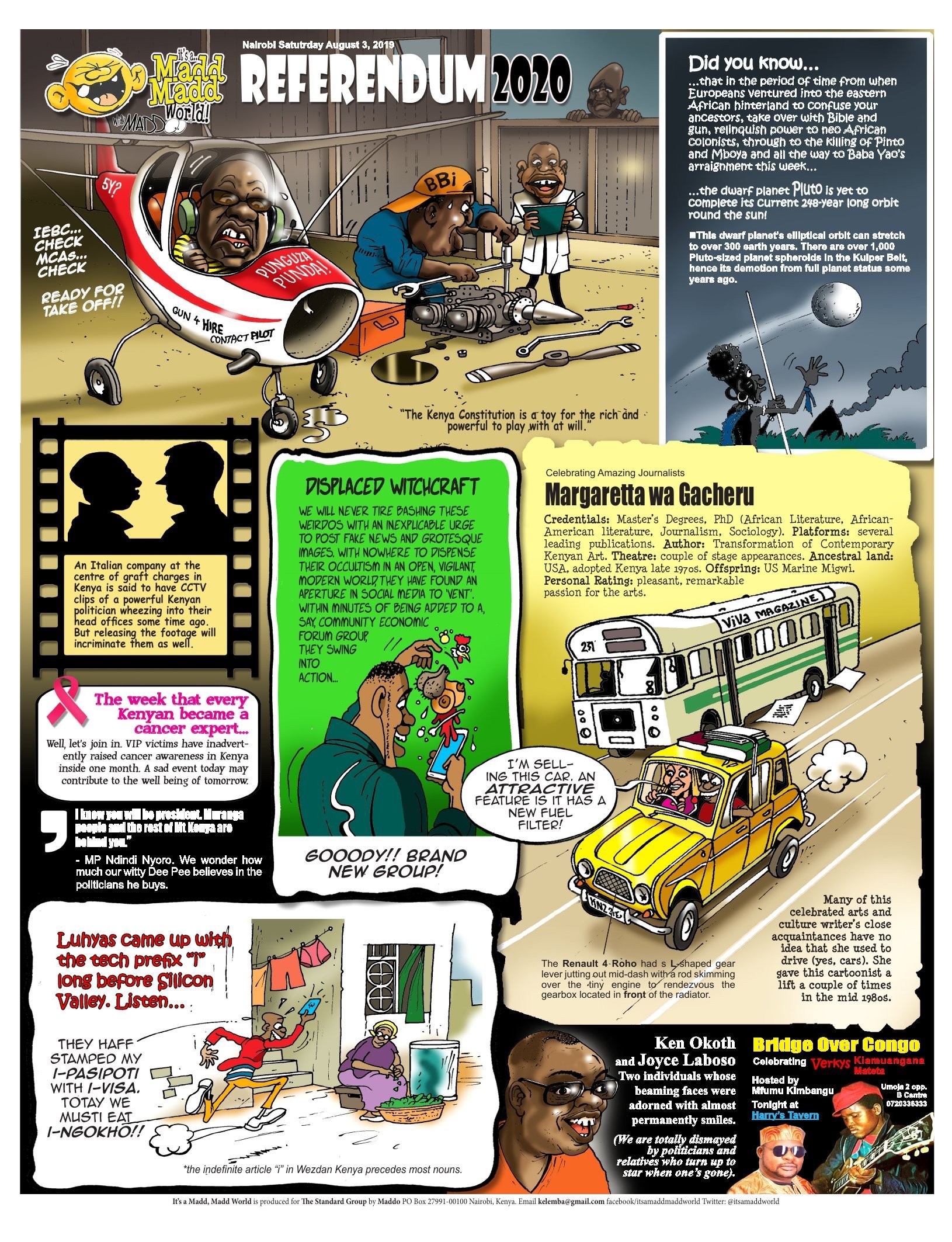
Down the left margin of the August 3, 2019 page of It’s a Madd, Madd World, a strip of cinema film holds a single frame: two black heads in profile, facing each other. A silhouette. A dark outline set on a yellow background that has two figures with remarkable features. While one has a long, Pinocchio-like nose, the other has a rounded one, but his most noteworthy feature is the kisogo (the nape). Neither has eyes, features or a name, but in a conspiratorial way, a Kenyan would tell you: “I see what you did there.”
The yellow caption box beneath them identifies them, and it does so carefully. “An Italian company at the centre of graft charges in Kenya,” it says, “is said to have” CCTV clips of a powerful Kenyan politician “wheezing into their head offices some time ago.” But releasing the footage, it adds, “would incriminate the company as well.”
The caption names no one, and neither does the page. However, this was happening on the backdrop of a simmering corruption scandal that eventually resulted in the then Treasury Cabinet Secretary Henry Rotich and other officials being charged over contracts awarded to the Italian firm CMC di Ravenna over the construction of the Arror and Kimwarer dams.
Years before digital photography took root, pictures were taken on rolls of film. The film was taken to a darkroom, where it was developed into what was called a negative—a thin, translucent strip on which the image appeared in reverse: light areas looked dark, and dark areas looked light.
To choose a photograph, the technician would hold the negative up to the light. Against its pale glow, the subject appeared as a dark silhouette, and each frame would be studied until the one the photographer wanted printed was found.
This is what the cartoonist did. In the vault where the CCTV clips were hidden, the cartoonist held the negative against the light and a silhouette appeared. What the silhouette did was specific. To the readers, it draws footage that may exist but may never be released and cannot be pinned to a face. However, and in very clever way, it implicates without identifying. Whether that was a deliberate editorial calculation, only Maddo can say. What the page shows is that the device was already in use and there was “evidence kwa kalatas.”
Five years later, during the youth-led anti-Finance Bill protests of June 2024, the black silhouette got amplified. Digital artist Kibet Bull held the negative against some glow and the silhouette told it all. Like the 2019 one, it didn’t name names and the possible “drama that could have been caught on the national cameras,” but it documented and spoke of what couldn’t be written or spoken. Without doubt, the silhouette became one of the defining visual emblems of a generation’s dissent that even got the artist into trouble.
However, placing the 2019 Saturday page beside a 2024 viral digital silhouette would tell only the final chapter of this fascinating story. The juxtaposition certainly shows how visual dissent travels across different media, years, and political climates. But it is more than a story of images passing from one era to another. It is about breaking new ground, raising the bar, and leaving the door open for others to enter, make the space their own, and use it effectively.
Across four decades, Paul Kelemba has used his pen to test the limits of what Kenyan cartoonists can draw, say, and survive. His political nerve and his visible mentorship make him a credible “OG” of Kenyan cartooning. He is certainly not its father or founder, but he is one of the artists who made it a place where civic courage, humour and a livelihood could coexist, and he is still handing that place on. In his own words, he is the “bridge.”
The bridge that helped to create the space in which Celeste could become Kenya’s first female editorial cartoonist; Gado pushed the ceilings in holding the duty bearers to account; John Kiarie “KJ” could reach young Kenyans through Head on Corrishon; Gammz could build his own satirical universe; the late Nanjero (Joshua Kuya) and Kibet Bull could turn a silhouette into a language of digital protest.
Act of Courage
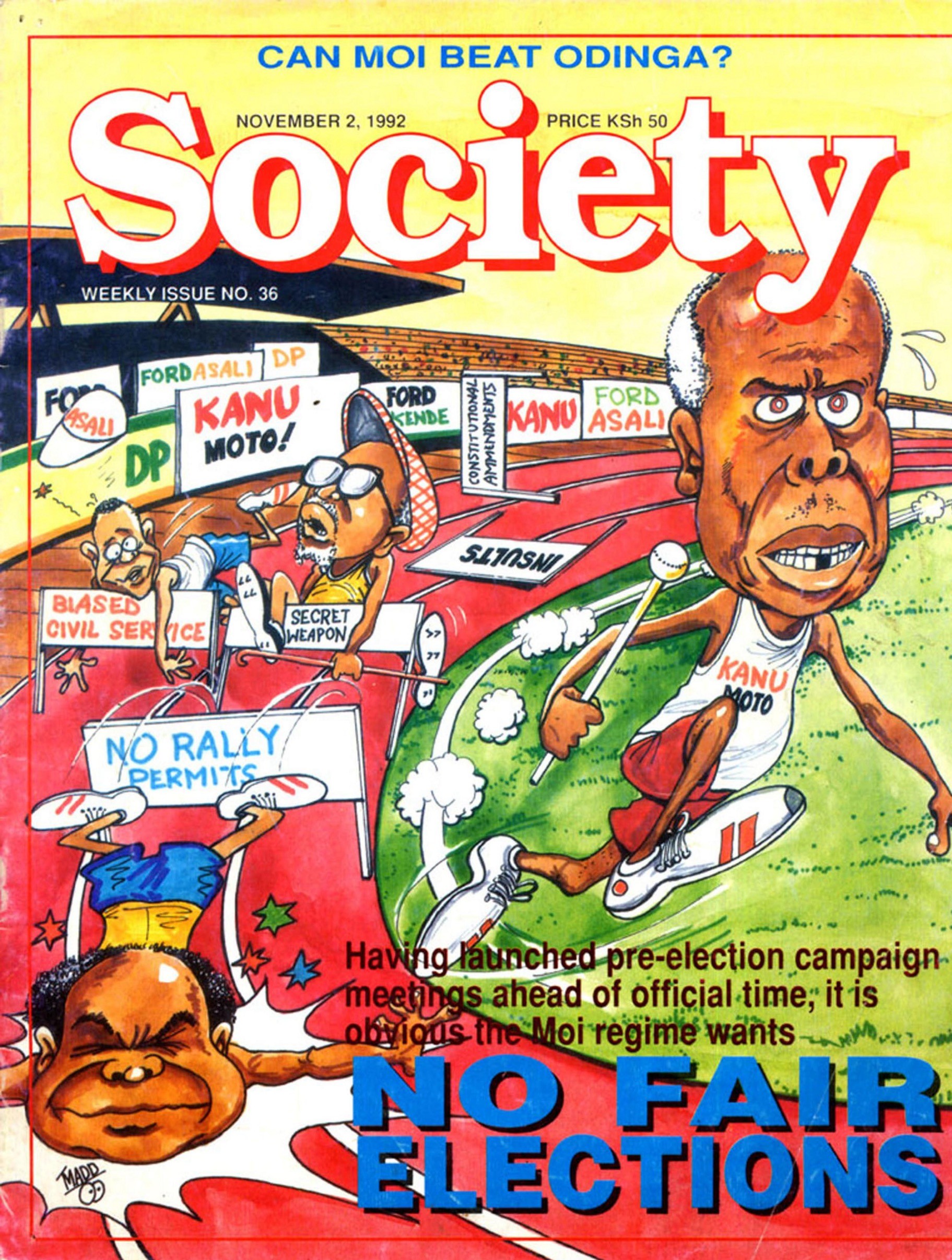
On November 2, 1992, Maddo had drawn the opposite of a shadow. He drew a face. In cover page of Society magazine's weekly issue, No. 36, he caricatured a sitting head of state in full colour at the height of the single-party repression. Working closely with Society magazine editors Mwenda Njoka and Pius Nyamora, backing the gamble, he showed that a Kenyan cartoonist could put the most powerful figure in the country into a drawing and survive professionally. He is often modest about this by pointing out that his was probably the first such cartoon openly published, but alleges that perhaps the university students could have beaten him to it by caricaturing him in the underground tunnel at the University of Nairobi linking the halls of residence and the lecture halls. Nonetheless, Maddo is widely credited as the first Kenyan cartoonist to caricature the sitting president Moi openly in what can only be described as an act of courage in a country where criticism could carry serious consequences.
In the late 1980s and early 1990s, Kenya’s political environment was tightly controlled. President Moi’s government tolerated little open dissent, and journalists, publishers, and activists who challenged the state risked harassment, arrest, detention, and prosecution. The Media Observer notes that “between 1988 and 1990, nearly 20 publications were shut down, while some of their editors were jailed, fined, or forced into exile.”
Society magazine, which published Maddo’s cartoon, operated squarely within this dangerous landscape. Founded by former Daily Nation journalist Pius Nyamora and his wife Loyce, the weekly became known for publishing stories critical of the government and testing the limits of press freedom. Its offices and printing operations were repeatedly targeted. In January 1992, more than 50 armed policemen raided the magazine’s printing firm before dawn, seizing about 30,000 copies of an upcoming issue, along with artwork and printing plates. The seizure effectively forced Society out of print for several months.
The intimidation extended beyond confiscated copies. On the eve of Good Friday in 1991, police raided Society’s offices at Tumaini House in Nairobi and arrested publisher Pius Nyamora, his wife Loyce, and journalists Mwenda Njoka, Mukalo wa Kwayera, and Laban Gitau. They were later charged with sedition. Court records indicate that Nyamora and some of his staff were arrested on several occasions, held in police cells in Nairobi, Kiambu, and Mombasa, and ultimately incarcerated at Shimo la Tewa Prison.
The threats were also physical. Society’s premises were firebombed, and Nyamora had previously survived an attack on his office. Even readers approached the magazine with caution: some feared arrest simply for carrying a copy, which could be treated as a “seditious publication.”
Against this backdrop, Maddo’s decision to caricature the president—and Society’s decision to place the image on its cover—was more than an editorial choice. It was a public challenge to a culture of fear. Maddo later recalled that he and Nyamora agreed to “test the waters,” knowing that the cartoon would provoke a response. In an era when the president’s image was largely beyond ridicule, Maddo’s cartoon helped break a powerful taboo: it showed that even the most feared man in Kenya could be drawn, questioned, and laughed at.
The Irony
“What was on my mind as I painted that cartoon was that we were on the threshold of Moi’s final years of absolute political control (I was so convinced that he would lose at the first multi-party polls),” Maddo said in an earlier interview. “If I was locked up, it wouldn’t be long before I was free again. But I also considered the other side; I had tried to convince my editor at The Standard, Ali Hafidh that we could start caricaturing the hitherto untouchable elements of the Kanu regime, but he would hear none of it. I did, however, slowly introduce Moi into my editorial cartoons under disguise. I had always figured out one thing: maybe Moi was not all that overly hostile about cartoons. The stumbling blocks were editors and Moi’s cronies who probably blacked out critical stories in a newspaper before giving it to him!”
The bold move was accepted and executed by a rival publication and while it demonstrated to all, even those at The Standard where he was working, that it could be done, he still couldn’t do it as much as he would have wanted since the President’s family had an interest in the media house. The new reality was that while he had made readers laugh and widened what a Kenyan cartoonist could imagine drawing, some institutional boundaries existed. He never got to enjoy this like he would have wanted, but the courage and opportunity was transferred to all the other cartoonists.
“Having survived that Monday,” Maddo noted in an interview, “the media, Kenyans and Kanu knew that Moi could be depicted in a cartoon. Daily Nation’s Gado (Godfrey Mwampembwa), freshly on the job, took cue and went on to produce some of the most stinging cartoons on the then president.”
In his assessment, Maddo pointed out that Gado, then drawing for the Daily Nation enjoyed greater latitude to test the same limits. However, he notes that the lesson was not that one cartoonist was brave and the other was not. Civic courage in cartooning is negotiated between the artist’s conviction and the institution that publishes the work.
It’s a Madd, Madd World: A Space that Lasted
While he faced limitations in expressing the same in a single panel, daily editorial cartoons, Maddo found his freedom in his weekly column It’s a Madd, Madd World. Started in October 1989, the column became a place where he could draw the then sitting president but in it, he has covered four Presidents -- Moi, Kibaki, Uhuru and now Ruto -- and a host of all the other opposition figures, the late Jaramogi, Raila, Wamalwa Kijana, and many others.
From a small quarter page column in the Nation, when he started, It’s a Madd, Madd World is a 37-years old full-page composite feature that has become a prolific socio-political satire and an engrossing Saturday ritual in which readers expect jokes, information and argument on one page. Within the column, Maddo continued to expand the boundaries and civic conversation as proven by the silhouette in the August 3, 2019 page.
In the process, It’s a Madd, Madd World became a platform that demonstrated a new world of possibilities, especially for many other fellow artists. For emerging artists watching from the margins, the column’s longevity mattered as much as any single provocative drawing. It showed that a self-taught artist, who had once skived accounting school to scribble comic thrillers with a ballpoint pen, could build an independent public voice, hold a loyal weekend readership and turn visual commentary into a profession.
The Bridge and not the Founder
Maddo does not describe himself as the father of Kenyan cartooning. In many conversations over the years, he has consistently pointed past himself, crediting that distinction to earlier artists such as Terry Hirst and Edward Gitau, creator of Juha Kalulu. His own word for his place in the story is more modest. Recently on the launch poster for his Madd, Madd World 2012–2016 collection, he describes himself as forming “a sort of bridge from the era of artists like Terry Hirst to the sleek new kids on the digital block”.
The bridge links the older editorial-cartoon tradition of political risk, newspaper satire and visual commentary to today’s digital comic and protest-image culture. It links individual artistic practice to a wider professional ecosystem of cartoonists, illustrators, animators and comic creators. And it links a generation that had to negotiate censorship and ownership with one that makes and circulates work on social platforms.
On this bridge, a number of artists have walked over it to showcase their work and at the same time keep the embers that Maddo has lit alive. Because Maddo helped normalise sustained, locally rooted satire, the artists who followed did not have to imitate him. They could use the space to pursue very different visions.
Different Voices, Shared Possibilities
Celeste (Celestine Wamiru), Kenya’s first female newspaper editorial cartoonist, entered a male-dominated newsroom culture and brought her own lens to political and social commentary, including through her column Upside Down. Her presence showed that the satirical space had to widen beyond a single demographic perspective.
“Paul Wanyaga, the then managing editor of People Daily, wanted to offer me a job, but I told him, no, no, no, let's go for this lady,” Maddo said in an interview for this story. “He agreed, and that's how she went and started doing the editorial cartooning and the composite column, Upside Down, that was inspired by It’s a Madd, Madd World.”
The current Member of Parliament for Dagoretti South, John Kiarie, popularly known as KJ, took the composite format in another direction in the Sunday Nation. His feature, first titled On a Head on Corrishon with the Youth and later known as Head on Corrishon, spoke to young Kenyans in Sheng, youth expressions and popular-culture references while still making room for political and social commentary and gave it a recognisable generational identity.
Unlike Maddo's It's a Madd, Madd World, which drew on a broad range of social and political observations, KJ's work spoke more directly to the experiences, interests and language of young Kenyans. It created room for political and social commentary while communicating through the humour, language and everyday experiences of its intended audience.
In my critical reading of the published work, the relationship between the two features is evident not simply in their subject matter, but also in their approach to the composite cartoon format: bringing together different observations, situations and ideas within a single feature. Yet KJ's work was not merely a reproduction of Maddo's approach. He adapted the format to address a different readership and a different cultural moment.
This distinction is important in that artistic influence does not necessarily result in imitation. A format can be borrowed, reworked and given a new purpose. KJ's Head on Corrishon illustrates how the possibilities opened up by Maddo's Madd World could be reinterpreted to create a distinct voice for a younger generation of readers.
The late Joshua Kuya, better known as Nanjero aka Makambo, also brought the composite approach to The Nairobian, drawing on the characters and conversations of Nairobi’s Eastlands. When Nanjero died in November 2021, Maddo recalled in a tribute that he had approached his editors with the idea of a feature in the style of Madd World and it was accepted.
Nanjero’s column called The Peculiar Nairobian, drew inspiration from the world around him. He was described as “an astute observer of everyday life, particularly the characters, conversations and amusing encounters in Nairobi's Eastlands neighbourhoods.” These observations provided the material for his cartoons, allowing him to weave his own stories and social commentary into the composite format.
Eric Ngammau began as Kiddo in The Standard’s Now magazine, where he used the composite format in his weekly column called Toons Tannoy, which targeted the teens and in a hilarious way, amplified the annoying yet mirthful teens traits. In Now magazine, he also ran a column titled Just Kidding and if you look closely, the way he drew his avatar had close resemblance to that of Maddo. Later on, Kiddo transitioned to Gammz, a name with its own style and audience. His path captures the difference between influence and imitation: Maddo’s example made the space imaginable, and Gammz made his own way through it.
Kenyan cartooning is not a neat family tree of disciples. Each of these artists exercised their own agency, borrowing the premise of fearless public commentary while rejecting, remixing or outgrowing the formats that came before.
The Digital Turn
The June 2024 Finance Bill protests made the smartphone a main stage of political dissent. Art- music, spoken word, etc. was central in the way it was organised and the voices of the youth amplified. Two years down the line, the most enduring memory of that protest are the black-and-white silhouettes that expressed the voices and concerns of a generation in an effective way.
Drawn by Gideon Kibet, known online as Kibet Bull, the silhouettes went viral and become one of the most recognisable images of Kenya’s Gen Z protest moment. Like the 2019 panel in the Madd, Madd World the names were withheld but the “negative” that was held against a light often produced the right picture the mind of the viewers. Kibet’s silhouettes that were also being published in a different platform unlike Maddo’s magazine and newspaper, told the stories of what was current and they were shared instantly. “They were built for a feed, understood in half a second, screenshotted, remixed and shared” and they spread like “a bush-fire in the harmattan, the image Achebe uses in Things Fall Apart.”
In the digital age, Kibet and many youth who adopted and embraced the use of the silhouettes bypassed newspaper editors, which removed institutional gatekeeping, and with it the institutional shelter that sometimes came attached. They went directly to the target audience, and this helped the protest a great deal.
Unlike Maddo, who escaped the wrath of the state machinery after he caricatured President Moi, Kibet Bull was not lucky. Kibet disappeared in late December 2024 and was found alive on 6 January 2025, after what reports described as an abduction. The risk that Maddo’s generation negotiated through editors and owners now falls directly on the individual artist.
A Living Legacy
Maddo continues to link the generation that navigated state censorship and corporate ownership with one redrawing the boundaries of civic participation online, through mentorship, workshops and daily engagement with younger illustrators and comic creators.
A living legacy is not measured by how faithfully younger artists copy a veteran’s hand. It is measured by whether the space he helped open grows wider, louder and harder to close. From a president’s face on a magazine cover in 1992, to a shadowy filmstrip frame on a Saturday page in 2019, to a stark digital silhouette on phone screens in 2024, the lineage endures, not as a school of imitation but as a continuing refusal to look away.
Msanii Kimani wa Wanjiru is a seasoned art journalist and a contributor to Books in Africa. kymsnetmedianetwork@gmail.com.
Featured Book
Related Book
Get to know more about the mentioned books
Related Article

From the President’s face to the Gen Z silhouette, a Maddo living legacy
By
Down the left margin of the August 3, 2019 page of It’s a Madd, Madd World, a strip of cinema film holds a single frame: two black heads in profile, facing each other. A silhouette. A dark outline set on a yellow background that has two figures with remarkable features. While one has a long, Pinocchio-like nose, the other has a rounded one, but his most noteworthy feature is the kisogo (the nape). Neither has eyes, features or a name, but in a conspiratorial way, a Kenyan would tell you: “I see what you did there.”
The yellow caption box beneath them identifies them, and it does so carefully. “An Italian company at the centre of graft charges in Kenya,” it says, “is said to have” CCTV clips of a powerful Kenyan politician “wheezing into their head offices some time ago.” But releasing the footage, it adds, “would incriminate the company as well.”
The caption names no one, and neither does the page. However, this was happening on the backdrop of a simmering corruption scandal that eventually resulted in the then Treasury Cabinet Secretary Henry Rotich and other officials being charged over contracts awarded to the Italian firm CMC di Ravenna over the construction of the Arror and Kimwarer dams.
Years before digital photography took root, pictures were taken on rolls of film. The film was taken to a darkroom, where it was developed into what was called a negative—a thin, translucent strip on which the image appeared in reverse: light areas looked dark, and dark areas looked light.
To choose a photograph, the technician would hold the negative up to the light. Against its pale glow, the subject appeared as a dark silhouette, and each frame would be studied until the one the photographer wanted printed was found.
This is what the cartoonist did. In the vault where the CCTV clips were hidden, the cartoonist held the negative against the light and a silhouette appeared. What the silhouette did was specific. To the readers, it draws footage that may exist but may never be released and cannot be pinned to a face. However, and in very clever way, it implicates without identifying. Whether that was a deliberate editorial calculation, only Maddo can say. What the page shows is that the device was already in use and there was “evidence kwa kalatas.”
Five years later, during the youth-led anti-Finance Bill protests of June 2024, the black silhouette got amplified. Digital artist Kibet Bull held the negative against some glow and the silhouette told it all. Like the 2019 one, it didn’t name names and the possible “drama that could have been caught on the national cameras,” but it documented and spoke of what couldn’t be written or spoken. Without doubt, the silhouette became one of the defining visual emblems of a generation’s dissent that even got the artist into trouble.
However, placing the 2019 Saturday page beside a 2024 viral digital silhouette would tell only the final chapter of this fascinating story. The juxtaposition certainly shows how visual dissent travels across different media, years, and political climates. But it is more than a story of images passing from one era to another. It is about breaking new ground, raising the bar, and leaving the door open for others to enter, make the space their own, and use it effectively.
Across four decades, Paul Kelemba has used his pen to test the limits of what Kenyan cartoonists can draw, say, and survive. His political nerve and his visible mentorship make him a credible “OG” of Kenyan cartooning. He is certainly not its father or founder, but he is one of the artists who made it a place where civic courage, humour and a livelihood could coexist, and he is still handing that place on. In his own words, he is the “bridge.”
The bridge that helped to create the space in which Celeste could become Kenya’s first female editorial cartoonist; Gado pushed the ceilings in holding the duty bearers to account; John Kiarie “KJ” could reach young Kenyans through Head on Corrishon; Gammz could build his own satirical universe; the late Nanjero (Joshua Kuya) and Kibet Bull could turn a silhouette into a language of digital protest.
Act of Courage
On November 2, 1992, Maddo had drawn the opposite of a shadow. He drew a face. In cover page of Society magazine's weekly issue, No. 36, he caricatured a sitting head of state in full colour at the height of the single-party repression. Working closely with Society magazine editors Mwenda Njoka and Pius Nyamora, backing the gamble, he showed that a Kenyan cartoonist could put the most powerful figure in the country into a drawing and survive professionally. He is often modest about this by pointing out that his was probably the first such cartoon openly published, but alleges that perhaps the university students could have beaten him to it by caricaturing him in the underground tunnel at the University of Nairobi linking the halls of residence and the lecture halls. Nonetheless, Maddo is widely credited as the first Kenyan cartoonist to caricature the sitting president Moi openly in what can only be described as an act of courage in a country where criticism could carry serious consequences.
In the late 1980s and early 1990s, Kenya’s political environment was tightly controlled. President Moi’s government tolerated little open dissent, and journalists, publishers, and activists who challenged the state risked harassment, arrest, detention, and prosecution. The Media Observer notes that “between 1988 and 1990, nearly 20 publications were shut down, while some of their editors were jailed, fined, or forced into exile.”
Society magazine, which published Maddo’s cartoon, operated squarely within this dangerous landscape. Founded by former Daily Nation journalist Pius Nyamora and his wife Loyce, the weekly became known for publishing stories critical of the government and testing the limits of press freedom. Its offices and printing operations were repeatedly targeted. In January 1992, more than 50 armed policemen raided the magazine’s printing firm before dawn, seizing about 30,000 copies of an upcoming issue, along with artwork and printing plates. The seizure effectively forced Society out of print for several months.
The intimidation extended beyond confiscated copies. On the eve of Good Friday in 1991, police raided Society’s offices at Tumaini House in Nairobi and arrested publisher Pius Nyamora, his wife Loyce, and journalists Mwenda Njoka, Mukalo wa Kwayera, and Laban Gitau. They were later charged with sedition. Court records indicate that Nyamora and some of his staff were arrested on several occasions, held in police cells in Nairobi, Kiambu, and Mombasa, and ultimately incarcerated at Shimo la Tewa Prison.
The threats were also physical. Society’s premises were firebombed, and Nyamora had previously survived an attack on his office. Even readers approached the magazine with caution: some feared arrest simply for carrying a copy, which could be treated as a “seditious publication.”
Against this backdrop, Maddo’s decision to caricature the president—and Society’s decision to place the image on its cover—was more than an editorial choice. It was a public challenge to a culture of fear. Maddo later recalled that he and Nyamora agreed to “test the waters,” knowing that the cartoon would provoke a response. In an era when the president’s image was largely beyond ridicule, Maddo’s cartoon helped break a powerful taboo: it showed that even the most feared man in Kenya could be drawn, questioned, and laughed at.
The Irony
“What was on my mind as I painted that cartoon was that we were on the threshold of Moi’s final years of absolute political control (I was so convinced that he would lose at the first multi-party polls),” Maddo said in an earlier interview. “If I was locked up, it wouldn’t be long before I was free again. But I also considered the other side; I had tried to convince my editor at The Standard, Ali Hafidh that we could start caricaturing the hitherto untouchable elements of the Kanu regime, but he would hear none of it. I did, however, slowly introduce Moi into my editorial cartoons under disguise. I had always figured out one thing: maybe Moi was not all that overly hostile about cartoons. The stumbling blocks were editors and Moi’s cronies who probably blacked out critical stories in a newspaper before giving it to him!”
The bold move was accepted and executed by a rival publication and while it demonstrated to all, even those at The Standard where he was working, that it could be done, he still couldn’t do it as much as he would have wanted since the President’s family had an interest in the media house. The new reality was that while he had made readers laugh and widened what a Kenyan cartoonist could imagine drawing, some institutional boundaries existed. He never got to enjoy this like he would have wanted, but the courage and opportunity was transferred to all the other cartoonists.
“Having survived that Monday,” Maddo noted in an interview, “the media, Kenyans and Kanu knew that Moi could be depicted in a cartoon. Daily Nation’s Gado (Godfrey Mwampembwa), freshly on the job, took cue and went on to produce some of the most stinging cartoons on the then president.”
In his assessment, Maddo pointed out that Gado, then drawing for the Daily Nation enjoyed greater latitude to test the same limits. However, he notes that the lesson was not that one cartoonist was brave and the other was not. Civic courage in cartooning is negotiated between the artist’s conviction and the institution that publishes the work.
It’s a Madd, Madd World: A Space that Lasted
While he faced limitations in expressing the same in a single panel, daily editorial cartoons, Maddo found his freedom in his weekly column It’s a Madd, Madd World. Started in October 1989, the column became a place where he could draw the then sitting president but in it, he has covered four Presidents -- Moi, Kibaki, Uhuru and now Ruto -- and a host of all the other opposition figures, the late Jaramogi, Raila, Wamalwa Kijana, and many others.
From a small quarter page column in the Nation, when he started, It’s a Madd, Madd World is a 37-years old full-page composite feature that has become a prolific socio-political satire and an engrossing Saturday ritual in which readers expect jokes, information and argument on one page. Within the column, Maddo continued to expand the boundaries and civic conversation as proven by the silhouette in the August 3, 2019 page.
In the process, It’s a Madd, Madd World became a platform that demonstrated a new world of possibilities, especially for many other fellow artists. For emerging artists watching from the margins, the column’s longevity mattered as much as any single provocative drawing. It showed that a self-taught artist, who had once skived accounting school to scribble comic thrillers with a ballpoint pen, could build an independent public voice, hold a loyal weekend readership and turn visual commentary into a profession.
The Bridge and not the Founder
Maddo does not describe himself as the father of Kenyan cartooning. In many conversations over the years, he has consistently pointed past himself, crediting that distinction to earlier artists such as Terry Hirst and Edward Gitau, creator of Juha Kalulu. His own word for his place in the story is more modest. Recently on the launch poster for his Madd, Madd World 2012–2016 collection, he describes himself as forming “a sort of bridge from the era of artists like Terry Hirst to the sleek new kids on the digital block”.
The bridge links the older editorial-cartoon tradition of political risk, newspaper satire and visual commentary to today’s digital comic and protest-image culture. It links individual artistic practice to a wider professional ecosystem of cartoonists, illustrators, animators and comic creators. And it links a generation that had to negotiate censorship and ownership with one that makes and circulates work on social platforms.
On this bridge, a number of artists have walked over it to showcase their work and at the same time keep the embers that Maddo has lit alive. Because Maddo helped normalise sustained, locally rooted satire, the artists who followed did not have to imitate him. They could use the space to pursue very different visions.
Different Voices, Shared Possibilities
Celeste (Celestine Wamiru), Kenya’s first female newspaper editorial cartoonist, entered a male-dominated newsroom culture and brought her own lens to political and social commentary, including through her column Upside Down. Her presence showed that the satirical space had to widen beyond a single demographic perspective.
“Paul Wanyaga, the then managing editor of People Daily, wanted to offer me a job, but I told him, no, no, no, let's go for this lady,” Maddo said in an interview for this story. “He agreed, and that's how she went and started doing the editorial cartooning and the composite column, Upside Down, that was inspired by It’s a Madd, Madd World.”
The current Member of Parliament for Dagoretti South, John Kiarie, popularly known as KJ, took the composite format in another direction in the Sunday Nation. His feature, first titled On a Head on Corrishon with the Youth and later known as Head on Corrishon, spoke to young Kenyans in Sheng, youth expressions and popular-culture references while still making room for political and social commentary and gave it a recognisable generational identity.
Unlike Maddo's It's a Madd, Madd World, which drew on a broad range of social and political observations, KJ's work spoke more directly to the experiences, interests and language of young Kenyans. It created room for political and social commentary while communicating through the humour, language and everyday experiences of its intended audience.
In my critical reading of the published work, the relationship between the two features is evident not simply in their subject matter, but also in their approach to the composite cartoon format: bringing together different observations, situations and ideas within a single feature. Yet KJ's work was not merely a reproduction of Maddo's approach. He adapted the format to address a different readership and a different cultural moment.
This distinction is important in that artistic influence does not necessarily result in imitation. A format can be borrowed, reworked and given a new purpose. KJ's Head on Corrishon illustrates how the possibilities opened up by Maddo's Madd World could be reinterpreted to create a distinct voice for a younger generation of readers.
The late Joshua Kuya, better known as Nanjero aka Makambo, also brought the composite approach to The Nairobian, drawing on the characters and conversations of Nairobi’s Eastlands. When Nanjero died in November 2021, Maddo recalled in a tribute that he had approached his editors with the idea of a feature in the style of Madd World and it was accepted.
Nanjero’s column called The Peculiar Nairobian, drew inspiration from the world around him. He was described as “an astute observer of everyday life, particularly the characters, conversations and amusing encounters in Nairobi's Eastlands neighbourhoods.” These observations provided the material for his cartoons, allowing him to weave his own stories and social commentary into the composite format.
Eric Ngammau began as Kiddo in The Standard’s Now magazine, where he used the composite format in his weekly column called Toons Tannoy, which targeted the teens and in a hilarious way, amplified the annoying yet mirthful teens traits. In Now magazine, he also ran a column titled Just Kidding and if you look closely, the way he drew his avatar had close resemblance to that of Maddo. Later on, Kiddo transitioned to Gammz, a name with its own style and audience. His path captures the difference between influence and imitation: Maddo’s example made the space imaginable, and Gammz made his own way through it.
Kenyan cartooning is not a neat family tree of disciples. Each of these artists exercised their own agency, borrowing the premise of fearless public commentary while rejecting, remixing or outgrowing the formats that came before.
The Digital Turn
The June 2024 Finance Bill protests made the smartphone a main stage of political dissent. Art- music, spoken word, etc. was central in the way it was organised and the voices of the youth amplified. Two years down the line, the most enduring memory of that protest are the black-and-white silhouettes that expressed the voices and concerns of a generation in an effective way.
Drawn by Gideon Kibet, known online as Kibet Bull, the silhouettes went viral and become one of the most recognisable images of Kenya’s Gen Z protest moment. Like the 2019 panel in the Madd, Madd World the names were withheld but the “negative” that was held against a light often produced the right picture the mind of the viewers. Kibet’s silhouettes that were also being published in a different platform unlike Maddo’s magazine and newspaper, told the stories of what was current and they were shared instantly. “They were built for a feed, understood in half a second, screenshotted, remixed and shared” and they spread like “a bush-fire in the harmattan, the image Achebe uses in Things Fall Apart.”
In the digital age, Kibet and many youth who adopted and embraced the use of the silhouettes bypassed newspaper editors, which removed institutional gatekeeping, and with it the institutional shelter that sometimes came attached. They went directly to the target audience, and this helped the protest a great deal.
Unlike Maddo, who escaped the wrath of the state machinery after he caricatured President Moi, Kibet Bull was not lucky. Kibet disappeared in late December 2024 and was found alive on 6 January 2025, after what reports described as an abduction. The risk that Maddo’s generation negotiated through editors and owners now falls directly on the individual artist.
A Living Legacy
Maddo continues to link the generation that navigated state censorship and corporate ownership with one redrawing the boundaries of civic participation online, through mentorship, workshops and daily engagement with younger illustrators and comic creators.
A living legacy is not measured by how faithfully younger artists copy a veteran’s hand. It is measured by whether the space he helped open grows wider, louder and harder to close. From a president’s face on a magazine cover in 1992, to a shadowy filmstrip frame on a Saturday page in 2019, to a stark digital silhouette on phone screens in 2024, the lineage endures, not as a school of imitation but as a continuing refusal to look away.
Msanii Kimani wa Wanjiru is a seasoned art journalist and a contributor to Books in Africa. kymsnetmedianetwork@gmail.com.
Share :


Lorem ipsum dolor sit amet, consectetur adipiscing elit. Suspendisse varius enim in eros elementum tristique. Duis cursus, mi quis viverra ornare, eros dolor interdum nulla, ut commodo diam libero vitae erat. Aenean faucibus nibh et justo cursus id rutrum lorem imperdiet. Nunc ut sem vitae risus tristique posuere.
Lorem ipsum dolor sit amet, consectetur adipiscing elit. Suspendisse varius enim in eros elementum tristique. Duis cursus, mi quis viverra ornare, eros dolor interdum nulla, ut commodo diam libero vitae erat. Aenean faucibus nibh et justo cursus id rutrum lorem imperdiet. Nunc ut sem vitae risus tristique posuere.