
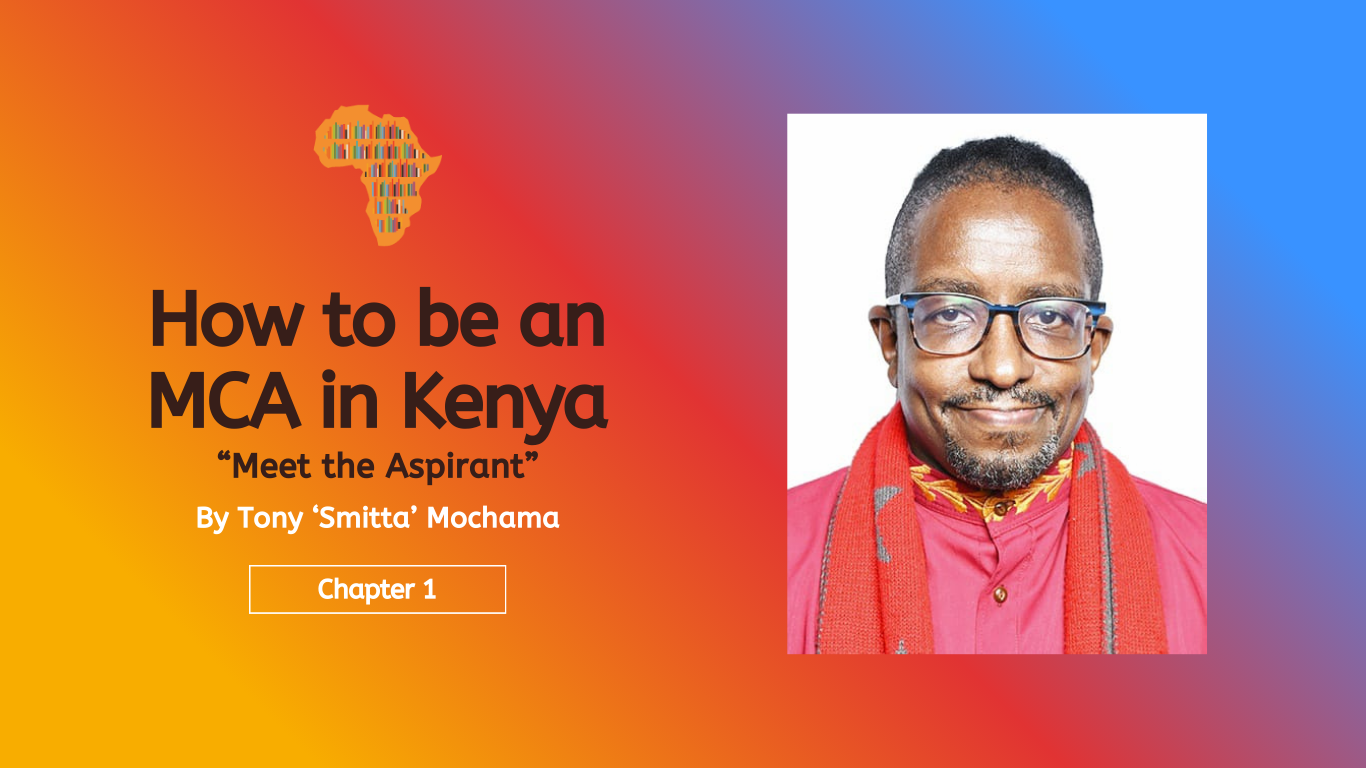

How to be an MCA In Kenya
A Guide for Gen X to Gen Z Who Want to Enter Politics in 2027
Part 1: Meet the Aspirant
In mid-October 2021, on Mashujaa Day, I returned from a regional conference in Dar es Salaam in neighbouring Tanzania titled, “Imperatives of Post-COVID Recovery: How Can the Resolution of the Sahara Issue Affect African Stability?” I walked into an empty apartment on Mukoma Road, South B, just a bridge and a road away from the ward called Nairobi West.
Stable, nyet! Save for the TV set, a couch, my bed, and my study, which she had left intact (complete with my bookcase), my partner of seven years had emptied the flat. She left it a bare echo chamber of footsteps, leaving me bereft of the pitter-patter of the tiny feet of my four-year-old boy—who considered me his personal hero and whom I had nicknamed “Leo Bomaye” after the chant of the pro-Muhammad Ali Congolese crowds in Kinshasa during the Rumble in the Jungle versus George Foreman. (The movie Big George Foreman is a great biopic and goes to show that, sometimes, quality and reception don’t match).
Anyway, a heroic decision on her part! (Bomaye means “kill ’em” in Lingala.)
About a month later, on 21 November 2021, I was summoned to the office of the administration manager of the newspaper I had been working for nearly 18 years. I was informed that the “boss,” a chap I’d nicknamed “Crapuro,” was letting me go on the last day of the year.
A brave decision on his part, as at the time, I was running the most popular column in the newspaper, a go-to weekly gossip piece titled “Scene @t” (under the moniker Smitta Smitten); the third most popular column in the newspaper, “Men Only”; as well as two other well-received columns, “The Bad Bachelor” (as Art Amacho) and “Baby’s Diary,” based on the weekly doings of my son. (That story, though, has a happy ending down the line, but it’s a tale for another book).
Congratulations, Mr. Crapuro—prescient, if not quite perfect timing!
(At the time of writing, after a huge haemorrhage of talent, the said media company is in dire circulation and financial strain. He was eventually fired, and a great new managing editor with bold headlines against the current regime is slowly getting the paper out of the ICU and into the HDU).
Here is something you need to know: blessings are served in single shots, troubles come in doubles, and tragedy is a straight-up triple tot. I was not surprised at all, on the Sunday of Jamhuri Day, to be served with a notice to evict.
Later on 20 December at the Karibuni Villas in Mambrui—a mere half-hour drive from the airport where I’d just landed—I was sitting beside an infinity pool seeking advice from the outgoing governor of Machakos and my good long-term friend, Dr. Alfred Mutua. A blue sky stretched above me, and a blue sea reached out into the distance.
Just six months before, Gov. Mutua had been the chief VIP guest at the launch of my book, Political Parties After Political Parties: The Changing Nature and Reality of Political Power in Kenya. I can never forget the lengths he went to keep his word—leaving a Maendeleo Chap Chap (MCC) political rally in Mombasa at noon just to catch a 1:00 p.m. plane to Nairobi, then blaring his way through World Rally Championship traffic gridlock in the Gigiri area to make it by 3:00 p.m. for the book launch.
Having survived his own separation strife, which was fodder for the media, Dr. Mutua—a witty, smart, and down-to-earth gentleman as well as an ardent patriot—was about to embark on a year that would see his MCC party frustrated out of the Azimio La Umoja One Kenya Coalition. He ended up in the Kenya Kwanza Alliance and was appointed Kenya’s Cabinet Secretary in the Ministry of Foreign Affairs within ten incredible months. He has since served as CS at both the tourism and labour ministries.
Like many men of a certain age who suddenly find themselves in new and unfamiliar terrain, feeling a sense of abandonment and betrayal, the siren call of politics in the year of a general election (2022) suddenly seemed very attractive. This was especially true if I could get an MCC ticket to run for MCA from one of the most developmentally progressive governors and dynamic young politicians Kenya has ever had—and a definite presidential prospect in the decade to come.
Kenya’s election years are a colourful canvas of campaigns and chaos, feuds and fundraising, bullying and voter bribery, slugging it out and sloganeering. Fifteen years after penning The Road to Eldoret (regarding the 2008 post-election violence), I had finally decided to throw my hat into the ring and join the circus of running for a local political office in Kenya.
The Hunt for “Red” August
“The theory has been advanced that the Age of Frustration is also mastered by an interest in local politics. It is now known, however, that men enter local politics solely as a result of being unhappily married!”— C. Northcote Parkinson
(Or divorced!)
There is also the matter of losing your long-time social status, brought about by a career that made you famous for 18 years, and seeking to recreate—or rather reinvent—yourself on the national stage by determining to become the most eloquent and progressive municipal legislator that the city of Nairobi has ever had since 1963.
Lofty aspirations by a “loco” aspirant for local office.
British Prime Minister Benjamin Disraeli, in his book Coningsby, envisages a “vast pile of municipal and local government.” In the 47 county assemblies of Kenya, the heads of these devolved units are the governors and the deputy governors. The elected Members of the County Assembly (MCAs) nationwide number 1,450, with a further 772 sitting as nominated members.
The total number of MCAs in Kenya is 2,222, which, like the biblical “666,” seems to be a beastly number—especially when one considers that the taxpayer forks out Ksh166,000 monthly per MCA salary, for a grand total of Ksh368,852,000 monthly, or Ksh4,426,224,000 per annum, from the National Treasury’s coffers.
Consequently, Coningsby’s imaginings can be applied to the City County Assembly sitting in City Hall on Nairobi’s City Hall Way, just opposite the Supreme Court and the iconic Kenyatta International Convention Centre (KICC).
The latter’s image in the public eye—aside from the collection of exorbitant land rates and all manner of odd certificates, like yellow fever inoculation forms—is one of a CBD nuisance and street cacophony. It is the Eden of crooked, weaselly wheeler-dealers, big and small (all stinky, cartel-like skunks), and a collective of city council askaris unaffectionately known as “Kanjo.” These officers emerge from the stony façade of City Hall with an air of benign inefficiency (like its clock, which has been stuck at two-past-ten since November 1989).
With its long-winded clerks and a distinct sense of menace, the askaris descend on street hawkers like malevolent hawks, venting indescribable fury on vendors with a rage out of all proportion to their misdemeanours (such as hawking without a licence). Especially in the evenings before the Nairobi sunset, they snatch wares, including second-hand clothing, and beat vendors brutally before hauling the captives into ramshackle vans with wire-mesh windows. They are then taken to the smelly cells of City Hall that stink like the soul of a kanjo!
This brutal city vulture cartel is resistant to change. With the MCAs virtually anonymous once they disappear into the cavernous corridors of City Hall, the askaris are free to thunder around and commit acts of extortion (and worse). Many of these acts fall under the “robbery with violence” category, which carries a death sentence, as does the odd murder committed by a kanjo during their hunting missions.
The numero uno agenda in my head, once I was in City Hall as an MCA, was to mercilessly go after the kanjo street cartels and legally clean out the Augean stables they had become, drafting a Bill to curtail their activities in Nairobi.
The municipal council had been overhauled through the Katiba (Constitution) of 2010. But though it had buried the past and caught up with the present, I thought the anomalous state in which “Kanjo” existed needed to be upgraded to the future, ASAP.
In short, the city assembly was still an anachronism, and new, eloquent faces (and voices against its faeces) were necessary from the ranks of media and professionals.
But first, I had to find a political party ticket to run on, failing which I would have to run as an independent candidate in the Nairobi West ward election of 2022.
This is the first installment of Tony Mochama’s upcoming book on his own experiences in his 2022 quest to become a Member of the County Assembly of Nairobi. Written in his characteristic flair and humour, it is a must-read for all persons interested in the raw political battles that define Kenya’s political landscape.
How to be an MCA In Kenya
By
A Guide for Gen X to Gen Z Who Want to Enter Politics in 2027
Part 1: Meet the Aspirant
In mid-October 2021, on Mashujaa Day, I returned from a regional conference in Dar es Salaam in neighbouring Tanzania titled, “Imperatives of Post-COVID Recovery: How Can the Resolution of the Sahara Issue Affect African Stability?” I walked into an empty apartment on Mukoma Road, South B, just a bridge and a road away from the ward called Nairobi West.
Stable, nyet! Save for the TV set, a couch, my bed, and my study, which she had left intact (complete with my bookcase), my partner of seven years had emptied the flat. She left it a bare echo chamber of footsteps, leaving me bereft of the pitter-patter of the tiny feet of my four-year-old boy—who considered me his personal hero and whom I had nicknamed “Leo Bomaye” after the chant of the pro-Muhammad Ali Congolese crowds in Kinshasa during the Rumble in the Jungle versus George Foreman. (The movie Big George Foreman is a great biopic and goes to show that, sometimes, quality and reception don’t match).
Anyway, a heroic decision on her part! (Bomaye means “kill ’em” in Lingala.)
About a month later, on 21 November 2021, I was summoned to the office of the administration manager of the newspaper I had been working for nearly 18 years. I was informed that the “boss,” a chap I’d nicknamed “Crapuro,” was letting me go on the last day of the year.
A brave decision on his part, as at the time, I was running the most popular column in the newspaper, a go-to weekly gossip piece titled “Scene @t” (under the moniker Smitta Smitten); the third most popular column in the newspaper, “Men Only”; as well as two other well-received columns, “The Bad Bachelor” (as Art Amacho) and “Baby’s Diary,” based on the weekly doings of my son. (That story, though, has a happy ending down the line, but it’s a tale for another book).
Congratulations, Mr. Crapuro—prescient, if not quite perfect timing!
(At the time of writing, after a huge haemorrhage of talent, the said media company is in dire circulation and financial strain. He was eventually fired, and a great new managing editor with bold headlines against the current regime is slowly getting the paper out of the ICU and into the HDU).
Here is something you need to know: blessings are served in single shots, troubles come in doubles, and tragedy is a straight-up triple tot. I was not surprised at all, on the Sunday of Jamhuri Day, to be served with a notice to evict.
Later on 20 December at the Karibuni Villas in Mambrui—a mere half-hour drive from the airport where I’d just landed—I was sitting beside an infinity pool seeking advice from the outgoing governor of Machakos and my good long-term friend, Dr. Alfred Mutua. A blue sky stretched above me, and a blue sea reached out into the distance.
Just six months before, Gov. Mutua had been the chief VIP guest at the launch of my book, Political Parties After Political Parties: The Changing Nature and Reality of Political Power in Kenya. I can never forget the lengths he went to keep his word—leaving a Maendeleo Chap Chap (MCC) political rally in Mombasa at noon just to catch a 1:00 p.m. plane to Nairobi, then blaring his way through World Rally Championship traffic gridlock in the Gigiri area to make it by 3:00 p.m. for the book launch.
Having survived his own separation strife, which was fodder for the media, Dr. Mutua—a witty, smart, and down-to-earth gentleman as well as an ardent patriot—was about to embark on a year that would see his MCC party frustrated out of the Azimio La Umoja One Kenya Coalition. He ended up in the Kenya Kwanza Alliance and was appointed Kenya’s Cabinet Secretary in the Ministry of Foreign Affairs within ten incredible months. He has since served as CS at both the tourism and labour ministries.
Like many men of a certain age who suddenly find themselves in new and unfamiliar terrain, feeling a sense of abandonment and betrayal, the siren call of politics in the year of a general election (2022) suddenly seemed very attractive. This was especially true if I could get an MCC ticket to run for MCA from one of the most developmentally progressive governors and dynamic young politicians Kenya has ever had—and a definite presidential prospect in the decade to come.
Kenya’s election years are a colourful canvas of campaigns and chaos, feuds and fundraising, bullying and voter bribery, slugging it out and sloganeering. Fifteen years after penning The Road to Eldoret (regarding the 2008 post-election violence), I had finally decided to throw my hat into the ring and join the circus of running for a local political office in Kenya.
The Hunt for “Red” August
“The theory has been advanced that the Age of Frustration is also mastered by an interest in local politics. It is now known, however, that men enter local politics solely as a result of being unhappily married!”— C. Northcote Parkinson
(Or divorced!)
There is also the matter of losing your long-time social status, brought about by a career that made you famous for 18 years, and seeking to recreate—or rather reinvent—yourself on the national stage by determining to become the most eloquent and progressive municipal legislator that the city of Nairobi has ever had since 1963.
Lofty aspirations by a “loco” aspirant for local office.
British Prime Minister Benjamin Disraeli, in his book Coningsby, envisages a “vast pile of municipal and local government.” In the 47 county assemblies of Kenya, the heads of these devolved units are the governors and the deputy governors. The elected Members of the County Assembly (MCAs) nationwide number 1,450, with a further 772 sitting as nominated members.
The total number of MCAs in Kenya is 2,222, which, like the biblical “666,” seems to be a beastly number—especially when one considers that the taxpayer forks out Ksh166,000 monthly per MCA salary, for a grand total of Ksh368,852,000 monthly, or Ksh4,426,224,000 per annum, from the National Treasury’s coffers.
Consequently, Coningsby’s imaginings can be applied to the City County Assembly sitting in City Hall on Nairobi’s City Hall Way, just opposite the Supreme Court and the iconic Kenyatta International Convention Centre (KICC).
The latter’s image in the public eye—aside from the collection of exorbitant land rates and all manner of odd certificates, like yellow fever inoculation forms—is one of a CBD nuisance and street cacophony. It is the Eden of crooked, weaselly wheeler-dealers, big and small (all stinky, cartel-like skunks), and a collective of city council askaris unaffectionately known as “Kanjo.” These officers emerge from the stony façade of City Hall with an air of benign inefficiency (like its clock, which has been stuck at two-past-ten since November 1989).
With its long-winded clerks and a distinct sense of menace, the askaris descend on street hawkers like malevolent hawks, venting indescribable fury on vendors with a rage out of all proportion to their misdemeanours (such as hawking without a licence). Especially in the evenings before the Nairobi sunset, they snatch wares, including second-hand clothing, and beat vendors brutally before hauling the captives into ramshackle vans with wire-mesh windows. They are then taken to the smelly cells of City Hall that stink like the soul of a kanjo!
This brutal city vulture cartel is resistant to change. With the MCAs virtually anonymous once they disappear into the cavernous corridors of City Hall, the askaris are free to thunder around and commit acts of extortion (and worse). Many of these acts fall under the “robbery with violence” category, which carries a death sentence, as does the odd murder committed by a kanjo during their hunting missions.
The numero uno agenda in my head, once I was in City Hall as an MCA, was to mercilessly go after the kanjo street cartels and legally clean out the Augean stables they had become, drafting a Bill to curtail their activities in Nairobi.
The municipal council had been overhauled through the Katiba (Constitution) of 2010. But though it had buried the past and caught up with the present, I thought the anomalous state in which “Kanjo” existed needed to be upgraded to the future, ASAP.
In short, the city assembly was still an anachronism, and new, eloquent faces (and voices against its faeces) were necessary from the ranks of media and professionals.
But first, I had to find a political party ticket to run on, failing which I would have to run as an independent candidate in the Nairobi West ward election of 2022.
This is the first installment of Tony Mochama’s upcoming book on his own experiences in his 2022 quest to become a Member of the County Assembly of Nairobi. Written in his characteristic flair and humour, it is a must-read for all persons interested in the raw political battles that define Kenya’s political landscape.
Share :


Lorem ipsum dolor sit amet, consectetur adipiscing elit. Suspendisse varius enim in eros elementum tristique. Duis cursus, mi quis viverra ornare, eros dolor interdum nulla, ut commodo diam libero vitae erat. Aenean faucibus nibh et justo cursus id rutrum lorem imperdiet. Nunc ut sem vitae risus tristique posuere.
Lorem ipsum dolor sit amet, consectetur adipiscing elit. Suspendisse varius enim in eros elementum tristique. Duis cursus, mi quis viverra ornare, eros dolor interdum nulla, ut commodo diam libero vitae erat. Aenean faucibus nibh et justo cursus id rutrum lorem imperdiet. Nunc ut sem vitae risus tristique posuere.