

Kenya’s 2010 Constitution turns sixteen, but has it changed the way power is acquired, exercised and experienced?
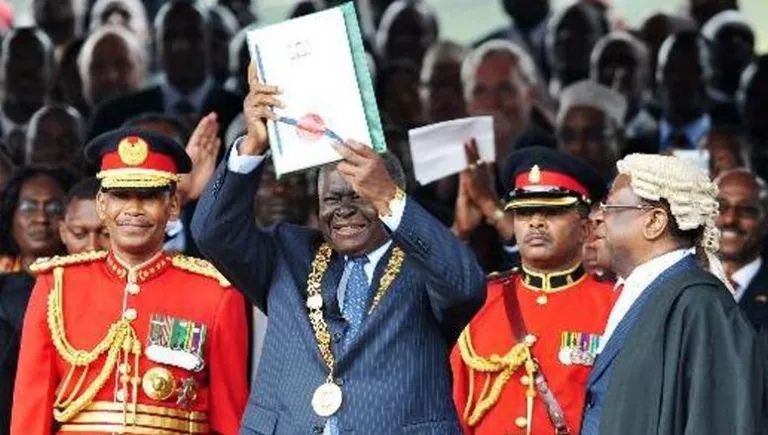
You probably remember the epic moment when the late Mwai Kibaki lifted and presented the newly promulgated Constitution to the masses at Uhuru Park on 27 August 2010.
Kibaki, then Kenya’s third president, stood before a sea of people, holding the Constitution above his head as the crowd erupted in joy around him. There is something almost tangible about the mood in that photograph—the jubilation, the relief, the sense that the country had finally arrived at a moment it had spent decades fighting for.
For many Kenyans, that day represented more than the adoption of a new legal document. The 2010 Constitution was the product of a long and often painful struggle to remake the Kenyan state: to curb the concentration of power in the presidency, strengthen institutions, protect fundamental rights, redistribute resources and political power through devolution, and give citizens a greater say in how they were governed.
The crowds at Uhuru Park were not celebrating legalese, but possibility.
Sixteen years later, here we are. Kenya’s Constitution is now16. And perhaps 16 is a good age for a little self-reflection.
What was the Constitution supposed to do for Kenya? What did Kenyans imagine they were voting for when they overwhelmingly approved it in the August 2010 referendum? And, sixteen years after Kibaki raised it above his head before a jubilant nation, how much of that promise has actually made its way into the Kenya we live in today?
To answer that, we have to return to one of the most fundamental ideas at the heart of the 2010 Constitution: sovereignty belongs to the people.
“The people may”
All sovereign power belongs to the people of Kenya and shall be exercised only in accordance with this Constitution. The people may exercise their sovereign power either directly or through their democratically elected representatives.
There is a piece of footage from the constitutional review process that has acquired a life of its own. In it, one Kenyan, Michael Kojo Otieno, participating in the National Dialogue Committee NADCO in 2023 public discussion places particular emphasis on the words “the people may” as he reads through the proposed constitutional language. The moment is striking because it captures, in a few words, one of the most consequential ideas in the Constitution that Kenyans would eventually adopt.
Article 1 of the 2010 Constitution states that all sovereign power belongs to the people of Kenya and that that power may be exercised directly or through democratically elected representatives. The language is deceptively simple, placing the Kenyan citizen at the centre of the constitutional order. For years, this sounded like an abstract constitutional principle:the sort of sentence that lives comfortably in law books and civics lessons for lawyers and political analysts to drop in discussions. More like lip service. Then came 2024.
In June of that year, thousands of young Kenyans took to the streets to oppose the Finance Bill, 2024. What began as resistance to proposed tax measures quickly developed into a broader confrontation over representation, accountability and the relationship between citizens and the political class. Young Kenyans were not simply asking the government to change a tax proposal. They were questioning whether the people they had elected were acting in their interests.
Some MPs faced intense public backlash over their positions on the Bill and calls for political accountability grew. The language of representation became unavoidable: Who does an elected representative actually represent when the people who elected them believe they have stopped listening? It was a distinctly constitutional question, even when it was being asked on the streets rather than in a courtroom.
The generation that came of age under the 2010 Constitution was asserting its political agency in a way that made the words of Article 1 feel considerably less abstract.
“The people may.”
“They may participate.”
“They may petition.”
“They may demonstrate.”
“They may demand accountability from those exercising power in their name.”
The Constitution's promise of popular sovereignty had collided with the reality of Kenyan politics. And this is perhaps one of the most interesting measures of the Constitution at 16: its language has entered the political imagination of a generation that was not even old enough to vote when it was promulgated.
That does not mean the Constitution created the 2024 protests. Neither does it mean every demand made by the protesters was a direct invocation of constitutional law. The protests had their own history, grievances and political dynamics. But the constitutional framework gave those grievances a language.
The question was no longer simply whether the government could make a particular decision. It was whether it could make that decision in the name of the people while the people themselves were saying no.
That tension sits at the heart of the constitutional experiment.
Because the 2010 Constitution did not merely promise Kenyans better government. It attempted to redefine the relationship between the citizen and the state. The question, sixteen years later, is whether that relationship has actually changed.
Taking power away from the centre
One of the most consequential ideas in the 2010 Constitution was that Kenya could no longer be governed as a country in which political and economic power flowed overwhelmingly from Nairobi.
For much of independent Kenya's history, the central government held enormous influence over the distribution of resources and the affairs of local communities. The presidency, in particular, became the centre of political life. Who occupied State House mattered enormously because so much depended on who was closest to it.
Devolution was designed to change that.
The creation of 47 county governments was not simply an exercise in administrative restructuring. It was an attempt to redistribute political and economic power, take government closer to citizens and address the marginalisation that had accompanied Kenya's highly centralised state.
Sixteen years on, the question is bigger than whether counties work.
Did devolution actually redistribute power, resources and political agency? And what happened to the old assumption that almost everything important in Kenya ultimately depended on who was sitting in State House?
A presidency that could no longer have everything
The second promise was closely connected to the third: the presidency was not supposed to remain the gravitational centre of the Kenyan state.
The 2010 Constitution placed limits around executive power while strengthening Parliament, the Judiciary and independent commissions. Presidential powers were defined within a broader system of checks and balances. This was a significant departure from the political culture that had developed under the previous constitutional order, where the presidency had accumulated extraordinary influence over the state. But constitutional design and political reality are not always the same thing.
Sixteen years later, Kenyan politics remain intensely presidential. Elections are still largely organised around the question of who will occupy State House. Political alliances are built around presidential ambitions. National political competition continues to carry enormous stakes.
Which raises an uncomfortable question:
Did the Constitution actually weaken the presidency, or did Kenyan politics simply become better at working around the limits placed on it?
Institutions that could say no
The 2010 Constitution also imagined a state in which institutions could hold one another to account.
The Judiciary was given greater constitutional authority. Parliament was strengthened. Independent commissions and offices were established with specific mandates. The Auditor-General and Controller of Budget were given important roles in scrutinising public finances. The IEBC was created as an independent electoral body.
The underlying idea was simple enough: power should not be able to mark its own homework.
Yet the test of institutional independence is not how an institution behaves when the political stakes are low but what happens when its decisions threaten powerful interests.
There have certainly been moments when Kenya's constitutional architecture has held. The Supreme Court's 2017 decision to annul the presidential election remains one of the clearest demonstrations that the post-2010 order could, at least at a critical moment, place constitutional procedure above political convenience.
But one dramatic demonstration of institutional power does not settle the question.
The more difficult audit is:
How often can Kenya's institutions constrain political power when the stakes are highest?
From subjects to rights-bearing citizens
Perhaps the most visible change in the constitutional order is the Bill of Rights.
The 2010 Constitution did not merely set out what the government should or should not do. It gave citizens a language and, crucially, legal mechanisms through which they could challenge the state.
Rights to equality and freedom from discrimination, freedom of expression, access to information, fair administrative action, health, housing, education and other protections changed the vocabulary of citizenship.
The Constitution also recognised groups that had historically occupied the margins of political power, including women, children and persons with disabilities.
But rights written into a constitutional document only become meaningful when people can exercise them.
So another question emerges:
Has the Constitution transformed Kenyans from subjects of government into rights-bearing citizens?
The answer cannot be found only in courtrooms. It is also found in what happens when an ordinary Kenyan challenges an administrative decision, demands information from a public institution, encounters the police, seeks a government service or insists that the state treat them according to the rights guaranteed to them.
This is where the lofty language of the Constitution meets everyday life.
Could the Constitution prevent another 2007?
The 2010 Constitution did not emerge from a vacuum. Its history is inseparable from the political crises that preceded it, particularly the 2007–08 post-election violence.
The constitutional reform project was, in part, an attempt to address the conditions that had made Kenya's political competition so combustible: an overpowered presidency, centralisation, inequality, historical grievances, marginalisation and an electoral system in which losing could feel like losing access to the state itself.
The new constitutional order was therefore expected to do more than distribute power differently. It was supposed to help Kenya manage political competition without repeatedly pushing the country towards crisis.
Sixteen years later, Kenya has not yet returned to the scale of violence witnessed after the 2007 election. That matters. But elections remain deeply personalised. Ethnic identity continues to influence political mobilisation. Electoral disputes remain intensely contested. Questions about state power, exclusion and accountability continue to animate Kenyan politics.
The uncomfortable historical question is therefore not whether the Constitution has prevented every political crisis.
It is: Did we change the rules of Kenyan politics without changing the incentives that made those old politics so powerful?
That may ultimately be the most important measure of the Katiba at 16.
Because the 2010 Constitution was never simply meant to give Kenya better laws but an attempt to give Kenya a different political order.
And perhaps that is what we should be auditing on its 16th birthday: not whether the Constitution has been obeyed perfectly, but whether it has fundamentally changed the way power is acquired, exercised and experienced in Kenya.
Tracy Ochieng is a staff writer with Books in Africa. Email: tracy.ochieng@ekitabu.com
Featured Book
.jpg)
Related Book
Get to know more about the mentioned books
Related Article
.jpg)
Kenya’s 2010 Constitution turns sixteen, but has it changed the way power is acquired, exercised and experienced?
By
You probably remember the epic moment when the late Mwai Kibaki lifted and presented the newly promulgated Constitution to the masses at Uhuru Park on 27 August 2010.
Kibaki, then Kenya’s third president, stood before a sea of people, holding the Constitution above his head as the crowd erupted in joy around him. There is something almost tangible about the mood in that photograph—the jubilation, the relief, the sense that the country had finally arrived at a moment it had spent decades fighting for.
For many Kenyans, that day represented more than the adoption of a new legal document. The 2010 Constitution was the product of a long and often painful struggle to remake the Kenyan state: to curb the concentration of power in the presidency, strengthen institutions, protect fundamental rights, redistribute resources and political power through devolution, and give citizens a greater say in how they were governed.
The crowds at Uhuru Park were not celebrating legalese, but possibility.
Sixteen years later, here we are. Kenya’s Constitution is now16. And perhaps 16 is a good age for a little self-reflection.
What was the Constitution supposed to do for Kenya? What did Kenyans imagine they were voting for when they overwhelmingly approved it in the August 2010 referendum? And, sixteen years after Kibaki raised it above his head before a jubilant nation, how much of that promise has actually made its way into the Kenya we live in today?
To answer that, we have to return to one of the most fundamental ideas at the heart of the 2010 Constitution: sovereignty belongs to the people.
“The people may”
All sovereign power belongs to the people of Kenya and shall be exercised only in accordance with this Constitution. The people may exercise their sovereign power either directly or through their democratically elected representatives.
There is a piece of footage from the constitutional review process that has acquired a life of its own. In it, one Kenyan, Michael Kojo Otieno, participating in the National Dialogue Committee NADCO in 2023 public discussion places particular emphasis on the words “the people may” as he reads through the proposed constitutional language. The moment is striking because it captures, in a few words, one of the most consequential ideas in the Constitution that Kenyans would eventually adopt.
Article 1 of the 2010 Constitution states that all sovereign power belongs to the people of Kenya and that that power may be exercised directly or through democratically elected representatives. The language is deceptively simple, placing the Kenyan citizen at the centre of the constitutional order. For years, this sounded like an abstract constitutional principle:the sort of sentence that lives comfortably in law books and civics lessons for lawyers and political analysts to drop in discussions. More like lip service. Then came 2024.
In June of that year, thousands of young Kenyans took to the streets to oppose the Finance Bill, 2024. What began as resistance to proposed tax measures quickly developed into a broader confrontation over representation, accountability and the relationship between citizens and the political class. Young Kenyans were not simply asking the government to change a tax proposal. They were questioning whether the people they had elected were acting in their interests.
Some MPs faced intense public backlash over their positions on the Bill and calls for political accountability grew. The language of representation became unavoidable: Who does an elected representative actually represent when the people who elected them believe they have stopped listening? It was a distinctly constitutional question, even when it was being asked on the streets rather than in a courtroom.
The generation that came of age under the 2010 Constitution was asserting its political agency in a way that made the words of Article 1 feel considerably less abstract.
“The people may.”
“They may participate.”
“They may petition.”
“They may demonstrate.”
“They may demand accountability from those exercising power in their name.”
The Constitution's promise of popular sovereignty had collided with the reality of Kenyan politics. And this is perhaps one of the most interesting measures of the Constitution at 16: its language has entered the political imagination of a generation that was not even old enough to vote when it was promulgated.
That does not mean the Constitution created the 2024 protests. Neither does it mean every demand made by the protesters was a direct invocation of constitutional law. The protests had their own history, grievances and political dynamics. But the constitutional framework gave those grievances a language.
The question was no longer simply whether the government could make a particular decision. It was whether it could make that decision in the name of the people while the people themselves were saying no.
That tension sits at the heart of the constitutional experiment.
Because the 2010 Constitution did not merely promise Kenyans better government. It attempted to redefine the relationship between the citizen and the state. The question, sixteen years later, is whether that relationship has actually changed.
Taking power away from the centre
One of the most consequential ideas in the 2010 Constitution was that Kenya could no longer be governed as a country in which political and economic power flowed overwhelmingly from Nairobi.
For much of independent Kenya's history, the central government held enormous influence over the distribution of resources and the affairs of local communities. The presidency, in particular, became the centre of political life. Who occupied State House mattered enormously because so much depended on who was closest to it.
Devolution was designed to change that.
The creation of 47 county governments was not simply an exercise in administrative restructuring. It was an attempt to redistribute political and economic power, take government closer to citizens and address the marginalisation that had accompanied Kenya's highly centralised state.
Sixteen years on, the question is bigger than whether counties work.
Did devolution actually redistribute power, resources and political agency? And what happened to the old assumption that almost everything important in Kenya ultimately depended on who was sitting in State House?
A presidency that could no longer have everything
The second promise was closely connected to the third: the presidency was not supposed to remain the gravitational centre of the Kenyan state.
The 2010 Constitution placed limits around executive power while strengthening Parliament, the Judiciary and independent commissions. Presidential powers were defined within a broader system of checks and balances. This was a significant departure from the political culture that had developed under the previous constitutional order, where the presidency had accumulated extraordinary influence over the state. But constitutional design and political reality are not always the same thing.
Sixteen years later, Kenyan politics remain intensely presidential. Elections are still largely organised around the question of who will occupy State House. Political alliances are built around presidential ambitions. National political competition continues to carry enormous stakes.
Which raises an uncomfortable question:
Did the Constitution actually weaken the presidency, or did Kenyan politics simply become better at working around the limits placed on it?
Institutions that could say no
The 2010 Constitution also imagined a state in which institutions could hold one another to account.
The Judiciary was given greater constitutional authority. Parliament was strengthened. Independent commissions and offices were established with specific mandates. The Auditor-General and Controller of Budget were given important roles in scrutinising public finances. The IEBC was created as an independent electoral body.
The underlying idea was simple enough: power should not be able to mark its own homework.
Yet the test of institutional independence is not how an institution behaves when the political stakes are low but what happens when its decisions threaten powerful interests.
There have certainly been moments when Kenya's constitutional architecture has held. The Supreme Court's 2017 decision to annul the presidential election remains one of the clearest demonstrations that the post-2010 order could, at least at a critical moment, place constitutional procedure above political convenience.
But one dramatic demonstration of institutional power does not settle the question.
The more difficult audit is:
How often can Kenya's institutions constrain political power when the stakes are highest?
From subjects to rights-bearing citizens
Perhaps the most visible change in the constitutional order is the Bill of Rights.
The 2010 Constitution did not merely set out what the government should or should not do. It gave citizens a language and, crucially, legal mechanisms through which they could challenge the state.
Rights to equality and freedom from discrimination, freedom of expression, access to information, fair administrative action, health, housing, education and other protections changed the vocabulary of citizenship.
The Constitution also recognised groups that had historically occupied the margins of political power, including women, children and persons with disabilities.
But rights written into a constitutional document only become meaningful when people can exercise them.
So another question emerges:
Has the Constitution transformed Kenyans from subjects of government into rights-bearing citizens?
The answer cannot be found only in courtrooms. It is also found in what happens when an ordinary Kenyan challenges an administrative decision, demands information from a public institution, encounters the police, seeks a government service or insists that the state treat them according to the rights guaranteed to them.
This is where the lofty language of the Constitution meets everyday life.
Could the Constitution prevent another 2007?
The 2010 Constitution did not emerge from a vacuum. Its history is inseparable from the political crises that preceded it, particularly the 2007–08 post-election violence.
The constitutional reform project was, in part, an attempt to address the conditions that had made Kenya's political competition so combustible: an overpowered presidency, centralisation, inequality, historical grievances, marginalisation and an electoral system in which losing could feel like losing access to the state itself.
The new constitutional order was therefore expected to do more than distribute power differently. It was supposed to help Kenya manage political competition without repeatedly pushing the country towards crisis.
Sixteen years later, Kenya has not yet returned to the scale of violence witnessed after the 2007 election. That matters. But elections remain deeply personalised. Ethnic identity continues to influence political mobilisation. Electoral disputes remain intensely contested. Questions about state power, exclusion and accountability continue to animate Kenyan politics.
The uncomfortable historical question is therefore not whether the Constitution has prevented every political crisis.
It is: Did we change the rules of Kenyan politics without changing the incentives that made those old politics so powerful?
That may ultimately be the most important measure of the Katiba at 16.
Because the 2010 Constitution was never simply meant to give Kenya better laws but an attempt to give Kenya a different political order.
And perhaps that is what we should be auditing on its 16th birthday: not whether the Constitution has been obeyed perfectly, but whether it has fundamentally changed the way power is acquired, exercised and experienced in Kenya.
Tracy Ochieng is a staff writer with Books in Africa. Email: tracy.ochieng@ekitabu.com
Share :


Lorem ipsum dolor sit amet, consectetur adipiscing elit. Suspendisse varius enim in eros elementum tristique. Duis cursus, mi quis viverra ornare, eros dolor interdum nulla, ut commodo diam libero vitae erat. Aenean faucibus nibh et justo cursus id rutrum lorem imperdiet. Nunc ut sem vitae risus tristique posuere.
Lorem ipsum dolor sit amet, consectetur adipiscing elit. Suspendisse varius enim in eros elementum tristique. Duis cursus, mi quis viverra ornare, eros dolor interdum nulla, ut commodo diam libero vitae erat. Aenean faucibus nibh et justo cursus id rutrum lorem imperdiet. Nunc ut sem vitae risus tristique posuere.