


Kinama’s vow to act on his turbulent lifestyle
Part 2
Finally, he found himself in the Uchumi Coffee Shop against his wish to have something different. He asked for coffee and two sausage rolls, then found himself a seat. He munched absent-mindedly. He debated whether he should stop drinking completely there and then; or for the sake of saying farewell to the bottle, simply give himself two or three bottles today, then close the chapter.
He pitied himself and worried about his turbulent life. Should he not finish this coffee and travel to the countryside without touching anything else to see his wife, Grace Kavuki?
The Coffee Shop was full of people of all races. Coffee lovers. At this time, you would always find a long queue. A favourite place for senior government officials from Jogoo House to come for a cup of coffee or a glass of milk and chat with a friend. At other times, it helped kill the boring time spent in government offices.
But today, Kinama was not here to kill time. Even in other times, this was not his place. He was a small bug who could not afford to come here frequently for coffee, meat-pies, sausage rolls and milk, except on a day like today. What had driven him to this place today, choosing a comer seat, was to seriously think
and decide on his next move, taking into consideration all the resolutions he had passed recently—particularly to amend his deteriorating general conduct.
He waited until he had finished his coffee, which he had brought in two cups. He opened the packet of cigarettes and lit one, taking time to reminisce over events of the past few months. He was caught in a terrible trap all because of one Anita. His mind ran back to the past: Where the hell is this Anita? He worried as he smoked. At least, he could say a proper goodbye to her today. He would perform one violent kwaheri with her then break off. One good kwaheri before taking the royal way to amend his life. He missed Anita.
Perhaps, after all, he had been in love with her in spite of her loose life. Such a beautiful woman, he lamented. Her voice haunted him, Oh Jona, you’re such a wonderful man Jona, you know your job, she cried whenever they were making love. Unfortunately, Anita had a mysterious character, a certain Maruka, who “kept” her. Perhaps after the bitter incident which nearly cost Kinama his life, Maruka had decided to hide Anita by keeping her in a secret place. Or perhaps he had murdered her; he was the kind of man who would murder a woman if provoked seriously.
The incident had shaken Kinama to the core.
After that, he had good reason to re-examine his life critically and decide whether to love himself better by becoming a good man. He would return to church
and try to develop new hobbies too—such as reading, playing football, or even starting a correspondence course to improve his education. He could also enrol himself in an evening class of some kind to learn karate or body-building.
Anita!
She had been living at Shauri Moyo Estate. Maruka had his own private accommodation at Eastleigh.
Once in a while, when Maruka was not busy with his most beloved magendo business in the night, he went to spend a night or two with Anita. Maruka
and Kinama shared one room at Eastleigh, rented by Maruka. The room belonged to a Somali lady. Since Maruka was absent from the house most days and nights, he had invited Kinama to temporarily share the rent. That was at a time when Kinama had a serious problem with accommodation.
Maruka and Kinama met casually in a nearby bar and bought each other drinks while discussing Kenyatta politics. But Kinama’s first meeting with Anita was in that same bar when she came with Maruka for a drink. He liked her immediately; but it was difficult for him to get to her. He figured the
only way was to befriend Maruka. And that was what he did. Not even Anita knew what business Maruka was engaged in. He was a man who successfully kept himself mysterious to others. He knew some working English and spoke first-class Kiswahili. He claimed to know Arabic and some Hindu.
Often, Maruka woke up before six in the morning and disappeared for the next two or three days. When he didn’t turn up for the night, Kinama thought he must have gone to see Anita; Maruka showered her with extravagant praise, particularly when drunk.
She’s a good cow worth the money I spend on her.
Anita was lavishly pampered. She wore expensive clothes, necklaces, and shoes. Her costly handbag always had lots of money. Kinama wondered whether Maruka could be a thief, some kind of city robber, because some of the items Anita got from him could only be bought by someone very wealthy. She had
a healthy bank account which, as she revealed to Kinama later, Maruka had no knowledge of, just as he didn’t know that she had a fifteen-year old daughter living in the countryside with her parents.
***
Kinama woke up from the long memory of his interlude with Anita and noticed the Coffee
Shop had become less full. How long had he relived the experience? During that time, he had heard no voice, seen nobody and not thought about his money. But now he felt for his money, then walked out. He had made up his mind to go back to the office, at least to show his face for that morning.
Where’s this Anita? he lamented with self-pity.
Anyway, I should forget her completely. Today, I would have been over three months dead because of that woman. For goodness sake, whatever gold she carries, I should forget her kabisa!
He sat in his office and day-dreamed, uninterested in the work. He worked reluctantly, like a convict.
Everything here seemed to nag him—the chair on which he sat was uncomfortable, his desk didn’t look good, and those files were piling up on his desk—hell!
“I’m not in the mood for work,” he told a workmate.
The workmate, one Kivala, replied, “Who the hell wants to work at the end of the month? You’re not alone. I need something to give me a fling today. I want to fuck until I ejaculate blood,” he said calmly, lit his cigarette and smoked silently and lugubriously, looking down.
“You’ve somebody reliable?” asked Kinama. “Nobody is reliable, all women bite. They are sweet
devils, you know.”
Another colleague protested, “Oh, don’t you people have anything else to think and talk about except that dirty game?”
“Such as?” Kivala snapped. “From the sound of your words, one would think Onesmus does not fuck. Sheep can be dirtier than goats, mark you.”
“Talk about films, books, gardening, God, friends, the sick!”
Kivala retorted, “Onesmus, you know, the mouth says, ‘I’m going to defecate’ although it is not the one that does so but the anus. I don’t trust that you are the Christian you pretend to be.”
“In all those things he thinks we should talk about,” Kinama added, “a woman must be directly involved or indirectly implied… we are talking about the same thing.”
“You people make me sick,” Onesmus answered, looking at Kivala. “There’s something terribly wrong in a person who thinks and talks about sex always.”
“But you always talk about money!” Challenged Kivala. “Do you think it is nobler to think and talk about money than to do so about women? You’re sick!”
“There’s nothing wrong in thinking…and talking about money,” he replied, “but… it’s maddening, he brought up his head, “most maddening to think… always about screwing, screwing—where are your brains?”
One Susie brought a file to Kinama. She loved teasing him. “You look like a sick bull, don’t you want to work?”
Kivala enjoyed this game of words. He took the answer out of Kinama’s mouth and replied to Susie, “He looks that sick because he hasn’t mounted any cow.”
“Hasn’t done what?”
Kinama studied the expensively dressed typist. “How old are you, Susie?” he asked.
“Why ask if you know that already?”
Then he had the words to tease back, I’m sure you stand in front of me to proudly show off those boils you call breasts—I don’t want them, please!”
“Beast!” she cried out.
“Know what?” Kinama added, “I started working when your mother was still bottle-feeding you. Now clear off my sight! “
Kivala added, “Before you are mounted.”
She replied by making a face and showing Kivala her tongue, then pulled away. Kinama and Kivala watched her from behind while Onesmus studied them. When she was out of sight, he told them, “Beware what you tell that spoilt woman. She’ll tell Ochwada everything.”
“Ochwada is her boss,” replied Kinama. “My boss is the Kenya Government. “
“Mine too,” added Kivala, “but not a confused blockhead of an Ochwada who buys girls sweets in order to sleep with them.”
* * *
Kinama formed his own theories about how Maruka had discovered the affair with Anita.
Obviously, Anita could not have told him. One theory was that Maruka’s suspicion was fuelled by Anita’s visible affluence. As Kinama had lavished money on her, she had bought herself new expensive clothes, shoes and handbags. He noticed she didn’t have the old tenderness anymore for him. She had also become harsh, careless and answered him back rudely.
He stood by the window on the fifth floor of the Sunrise Hotel surveying the busy Tom Mboya.
Street. Quite a commotion down there at the end of the month, always. He hadn’t decided to go to his country home yet. He also toyed with the idea of asking his wife to come to the city. They could shop together, make the new “constitution” and sign it.
He drew a big puff of smoke into his lungs thoughtfully and let it out by barely opening his mouth. The monotonous and noisy hoots of the matatu transport operators down there desecrated the peace of this street. Even from the fifth floor he could almost hear distinctly what route the matatu boys advertised loudly in their rivalry. There were many matatu passengers today. Each matatu came and
within no time was packed to the brim with travellers then left hurriedly, nearly bursting with people, some of whom clutched onto any available support both outside and inside. The matatu was usually so full that the front wheels barely touched the ground because of the excessive rear weight where most of the passengers gathered.
Once in a while, a car with a broken exhaust pipe would tear through the street blaring. Pedestrians hustled among each other, criss-crossing the road.
A husband or lover here and there trying to take his partner across the street; but sometimes the wife
or lover hesitated in the middle of the road… and appeared to wish to return to their side of the road for fear of the fast cars.
He watched the Nairobi parking boys who looked so small down there, like ants among the bigger fellows and the cars. The little fellows darted from one point to another with such daring movements. Rarely was a parking boy—most of them under ten—hit by
a car. They had mastered the behaviour of the traffic and knew precisely when to take chances… People of all walks of life were down there.
Even the pickpocket thieves, the swindlers, and the robbers. Some were armed, but how could you
make out who was armed since no one went about the street asking people to declare what they had in their pockets and handbags? It was a multiracial community where Indians, Africans and Europeans went about their private business harmoniously, with no apparent discrimination. Yet, beneath the surface, some tension existed between Africans and Indians. Some Africans felt strongly that most of the Indians, too, had developed a concealed dislike for them—claiming that these “lazy Africans” were out to grab the Indians’ hard-earned property.
The African-Indian cold war was noticeable except to the outsider, traveller, and less observant persons. Yet, all lived in this city in some kind of symbiosis with each other.
Was there a country in the whole world that didn’t have some kind of tension? Kinama wondered.
“The Indian community in Kenya,” one Indian said, “should be treated exactly as one of the tribes of Kenya…. In this case, the latest arrival.”
“All the tribes of Kenya are black, mark you,” replied a Kenyan. “Indians are not black—have you forgotten? They also discriminate against the black Indians in India. “
“We are all Kenyans, rafiki,” pointed out the Indian. There were nicknames for Indians—Patels,
Karasingas, pepper-eaters, Rufikis, and “These Indians,”—that Mamujee fought.
“There are bad Indians and good Indians, just as there are good and bad Africans.”
The African lost his patience and demanded, “You want me to buy that? Why are nearly all the Nairobi shops owned by Indians? Point number two, take the whole of the Industrial Area and the manufacturing centres, all Indian-dominated, kumanyoko!” He finished in a familiar curse word that Jomo Kenyatta used often in public when provoked.
The old man called a spade a spade when angry. “You should be grateful to Indians,” Mamujee
continued. “They teach you the art of trade. You have competitors from whom you can learn, see?”
Indian traders dominated Tom Mboya Street by then. Healthy Indian women in expensive saris dotted the streets, displaying naked parts of their trunks and shuffling in sandals… Just then, Kinama wondered what he could do to own one of the shops in this street. Even a kiosk—that would be good enough. You learn flying by taking little jumps first, he thought. I’m quite sure I could make something out of my life if I got myself organised.
He swallowed.
From tomorrow onwards, he assured himself, I shall walk upright and firmly like a man.
He inhaled another cloud from his cigarette, then extinguished its burning head on the window frame. He had taken a good bath. Now he felt clean and fresh. He had started to exercise his willpower already, having denied himself a beer up to now.
I shall give up smoking, too, he told himself aloud.
I’ll never die
***
He had a nightmare in which he squatted somewhere, studying a walking ant… Then the ant stopped, and all of a sudden changed into an extraordinarily big black bird. The bird stood before his eyes, getting ready to gouge out his eyes.
“Hey!” he cried in the dream in an effort to chase it away. But the bird made no move. He decided to give it one big blow with his hand. He drove the blow with all his might to strike it. The force in his subconscious cut through to his conscious life. He stirred up to wakefulness. His heart was in a frantic race and he was sweating. What a relief that it had been just a dream!
His bladder ached because it was so full. Then he became aware of his whereabouts, which he had been oblivious to on waking up.
He slowly started taking stock of his surroundings. “Where, where, what?” he cried and sat up urgently. There had been a Lilian here, where was she? Broad light behind the curtain—what time was it? He jumped out
of bed. Very early in the morning. Another horror struck him and dried up his urine—where was she? Could it be that—Oh no! He panicked to death. Jesus Christ,
let it not happen that this Lilian… He discovered that he was talking to himself aloud. The very first thing that had come to his mind suddenly was his big money. He snatched his jacket and checked all his pockets, getting more and more frantic.
His heart skipped a beat. There was absolutely no money!
Lilian could be playing tricks on him—he burst into the toilet where he thought she could be hiding, playing hide-and-seek. No, she wasn’t there either!
Not a single sign of Lilian in that room! His head started spinning… And before long, he fainted.
He didn’t know how long he had been unconscious. When he came to, he was back to his full senses. He knew that a woman called Lilian had robbed him of all his money. This time, he broke into tears and banged the floor in helplessness. But a sudden thought flashed and he dressed very quickly then rushed out, thinking Lilian might have woken up hungry and decided to have an early cup of tea downstairs. But then, why would she have taken
all that money with her? While running down he discovered that he had put on his shirt inside out. But
he didn’t have time to correct that. He burst into the dining hall--but Lilian wasn’t there either!
“Man, I have been robbed!” he said aloud. His voice attracted the attention of the only two couples having their breakfast. But Kinama was already out of the bar, into the street still hoping to find Lilian.
“The devil is not here!” he cried aloud.
Or was he in another nightmare? Was he really awake and seeing things in real life? He couldn’t trust his thoughts, ears, or eyes at that moment as he rushed back to the room.
The drama left everybody in the reception wondering. He searched everywhere again, even under the bed. He turned everything upside down, as if Lilian had become a ghost and could still be somewhere within the room with his money.
Kinama, he thought at the end of the race, you are dead now; I’m dead, dead!
He sat on the bed to weep. But there was another flash of thought that drove him running down to the reception. He interviewed everybody there concerning Lilian. Apparently, no one knew or seemed to recall her properly.
Furthermore, Kinama had not bothered to ask Lilian where she lived or what her tribe was, although that would help very little in finding her. Would a thief
camereveal their identity and place of residence simply like that?
It was after that interview when his bladder demanded a relief. Somehow, if he didn’t do it there and then, he would wet himself. The devil by the name Lilian had left him with mere coins, his suit and identity card. The expensive Oris watch had gone, too.
Six shillings and thirty cents only in his pocket, God of Abraham!
From the toilet, he returned to the reception and checked whether Milton had left any remainder of the beer from the crate. He had told Milton to leave a note there, signed by the manager. Yes, there was. A
credit of seven bottles. He asked for the beer, went to a comer and drank the seven bottles silently.
When the news had reached the bar manager that Kinama had been robbed, the manager came and tried to comfort Kinama and to sympathise with him by offering a few more bottles.
“I’m extremely sorry for you, brother,” the fat manager said. “One has got to be extremely careful with these town women. God, things that happen in this world!?”
When Kinama left the Sunrise Hotel much later, he was very drunk. The new beer had joined hands with the previous night’s, plus the hangover sickness. He
could hardly see his way out in the street. He walked awkwardly, uttering meaningless sentences and phrases and risking his life with the traffic. Did he know where he was going?
Featured Book

Related Book
Get to know more about the mentioned books
Related Article
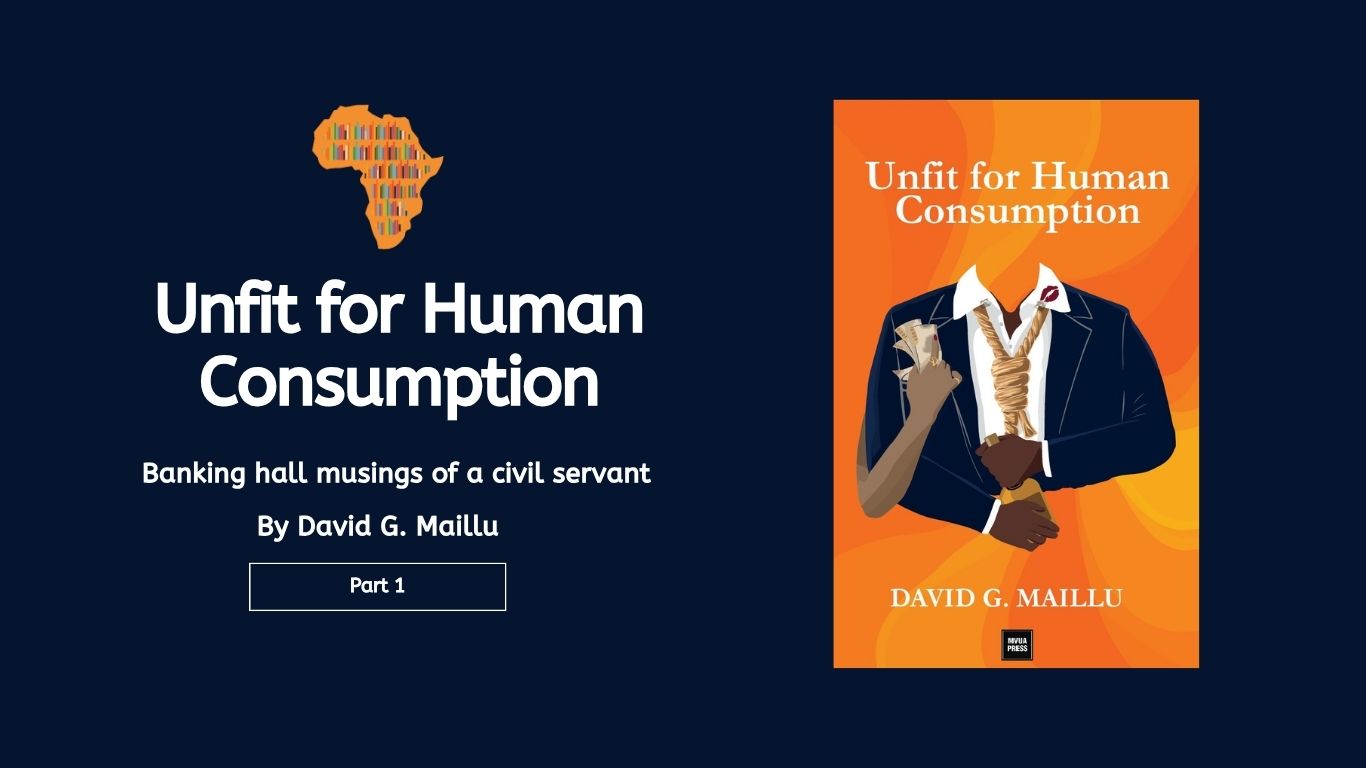
Kinama’s vow to act on his turbulent lifestyle
By
Part 2
Finally, he found himself in the Uchumi Coffee Shop against his wish to have something different. He asked for coffee and two sausage rolls, then found himself a seat. He munched absent-mindedly. He debated whether he should stop drinking completely there and then; or for the sake of saying farewell to the bottle, simply give himself two or three bottles today, then close the chapter.
He pitied himself and worried about his turbulent life. Should he not finish this coffee and travel to the countryside without touching anything else to see his wife, Grace Kavuki?
The Coffee Shop was full of people of all races. Coffee lovers. At this time, you would always find a long queue. A favourite place for senior government officials from Jogoo House to come for a cup of coffee or a glass of milk and chat with a friend. At other times, it helped kill the boring time spent in government offices.
But today, Kinama was not here to kill time. Even in other times, this was not his place. He was a small bug who could not afford to come here frequently for coffee, meat-pies, sausage rolls and milk, except on a day like today. What had driven him to this place today, choosing a comer seat, was to seriously think
and decide on his next move, taking into consideration all the resolutions he had passed recently—particularly to amend his deteriorating general conduct.
He waited until he had finished his coffee, which he had brought in two cups. He opened the packet of cigarettes and lit one, taking time to reminisce over events of the past few months. He was caught in a terrible trap all because of one Anita. His mind ran back to the past: Where the hell is this Anita? He worried as he smoked. At least, he could say a proper goodbye to her today. He would perform one violent kwaheri with her then break off. One good kwaheri before taking the royal way to amend his life. He missed Anita.
Perhaps, after all, he had been in love with her in spite of her loose life. Such a beautiful woman, he lamented. Her voice haunted him, Oh Jona, you’re such a wonderful man Jona, you know your job, she cried whenever they were making love. Unfortunately, Anita had a mysterious character, a certain Maruka, who “kept” her. Perhaps after the bitter incident which nearly cost Kinama his life, Maruka had decided to hide Anita by keeping her in a secret place. Or perhaps he had murdered her; he was the kind of man who would murder a woman if provoked seriously.
The incident had shaken Kinama to the core.
After that, he had good reason to re-examine his life critically and decide whether to love himself better by becoming a good man. He would return to church
and try to develop new hobbies too—such as reading, playing football, or even starting a correspondence course to improve his education. He could also enrol himself in an evening class of some kind to learn karate or body-building.
Anita!
She had been living at Shauri Moyo Estate. Maruka had his own private accommodation at Eastleigh.
Once in a while, when Maruka was not busy with his most beloved magendo business in the night, he went to spend a night or two with Anita. Maruka
and Kinama shared one room at Eastleigh, rented by Maruka. The room belonged to a Somali lady. Since Maruka was absent from the house most days and nights, he had invited Kinama to temporarily share the rent. That was at a time when Kinama had a serious problem with accommodation.
Maruka and Kinama met casually in a nearby bar and bought each other drinks while discussing Kenyatta politics. But Kinama’s first meeting with Anita was in that same bar when she came with Maruka for a drink. He liked her immediately; but it was difficult for him to get to her. He figured the
only way was to befriend Maruka. And that was what he did. Not even Anita knew what business Maruka was engaged in. He was a man who successfully kept himself mysterious to others. He knew some working English and spoke first-class Kiswahili. He claimed to know Arabic and some Hindu.
Often, Maruka woke up before six in the morning and disappeared for the next two or three days. When he didn’t turn up for the night, Kinama thought he must have gone to see Anita; Maruka showered her with extravagant praise, particularly when drunk.
She’s a good cow worth the money I spend on her.
Anita was lavishly pampered. She wore expensive clothes, necklaces, and shoes. Her costly handbag always had lots of money. Kinama wondered whether Maruka could be a thief, some kind of city robber, because some of the items Anita got from him could only be bought by someone very wealthy. She had
a healthy bank account which, as she revealed to Kinama later, Maruka had no knowledge of, just as he didn’t know that she had a fifteen-year old daughter living in the countryside with her parents.
***
Kinama woke up from the long memory of his interlude with Anita and noticed the Coffee
Shop had become less full. How long had he relived the experience? During that time, he had heard no voice, seen nobody and not thought about his money. But now he felt for his money, then walked out. He had made up his mind to go back to the office, at least to show his face for that morning.
Where’s this Anita? he lamented with self-pity.
Anyway, I should forget her completely. Today, I would have been over three months dead because of that woman. For goodness sake, whatever gold she carries, I should forget her kabisa!
He sat in his office and day-dreamed, uninterested in the work. He worked reluctantly, like a convict.
Everything here seemed to nag him—the chair on which he sat was uncomfortable, his desk didn’t look good, and those files were piling up on his desk—hell!
“I’m not in the mood for work,” he told a workmate.
The workmate, one Kivala, replied, “Who the hell wants to work at the end of the month? You’re not alone. I need something to give me a fling today. I want to fuck until I ejaculate blood,” he said calmly, lit his cigarette and smoked silently and lugubriously, looking down.
“You’ve somebody reliable?” asked Kinama. “Nobody is reliable, all women bite. They are sweet
devils, you know.”
Another colleague protested, “Oh, don’t you people have anything else to think and talk about except that dirty game?”
“Such as?” Kivala snapped. “From the sound of your words, one would think Onesmus does not fuck. Sheep can be dirtier than goats, mark you.”
“Talk about films, books, gardening, God, friends, the sick!”
Kivala retorted, “Onesmus, you know, the mouth says, ‘I’m going to defecate’ although it is not the one that does so but the anus. I don’t trust that you are the Christian you pretend to be.”
“In all those things he thinks we should talk about,” Kinama added, “a woman must be directly involved or indirectly implied… we are talking about the same thing.”
“You people make me sick,” Onesmus answered, looking at Kivala. “There’s something terribly wrong in a person who thinks and talks about sex always.”
“But you always talk about money!” Challenged Kivala. “Do you think it is nobler to think and talk about money than to do so about women? You’re sick!”
“There’s nothing wrong in thinking…and talking about money,” he replied, “but… it’s maddening, he brought up his head, “most maddening to think… always about screwing, screwing—where are your brains?”
One Susie brought a file to Kinama. She loved teasing him. “You look like a sick bull, don’t you want to work?”
Kivala enjoyed this game of words. He took the answer out of Kinama’s mouth and replied to Susie, “He looks that sick because he hasn’t mounted any cow.”
“Hasn’t done what?”
Kinama studied the expensively dressed typist. “How old are you, Susie?” he asked.
“Why ask if you know that already?”
Then he had the words to tease back, I’m sure you stand in front of me to proudly show off those boils you call breasts—I don’t want them, please!”
“Beast!” she cried out.
“Know what?” Kinama added, “I started working when your mother was still bottle-feeding you. Now clear off my sight! “
Kivala added, “Before you are mounted.”
She replied by making a face and showing Kivala her tongue, then pulled away. Kinama and Kivala watched her from behind while Onesmus studied them. When she was out of sight, he told them, “Beware what you tell that spoilt woman. She’ll tell Ochwada everything.”
“Ochwada is her boss,” replied Kinama. “My boss is the Kenya Government. “
“Mine too,” added Kivala, “but not a confused blockhead of an Ochwada who buys girls sweets in order to sleep with them.”
* * *
Kinama formed his own theories about how Maruka had discovered the affair with Anita.
Obviously, Anita could not have told him. One theory was that Maruka’s suspicion was fuelled by Anita’s visible affluence. As Kinama had lavished money on her, she had bought herself new expensive clothes, shoes and handbags. He noticed she didn’t have the old tenderness anymore for him. She had also become harsh, careless and answered him back rudely.
He stood by the window on the fifth floor of the Sunrise Hotel surveying the busy Tom Mboya.
Street. Quite a commotion down there at the end of the month, always. He hadn’t decided to go to his country home yet. He also toyed with the idea of asking his wife to come to the city. They could shop together, make the new “constitution” and sign it.
He drew a big puff of smoke into his lungs thoughtfully and let it out by barely opening his mouth. The monotonous and noisy hoots of the matatu transport operators down there desecrated the peace of this street. Even from the fifth floor he could almost hear distinctly what route the matatu boys advertised loudly in their rivalry. There were many matatu passengers today. Each matatu came and
within no time was packed to the brim with travellers then left hurriedly, nearly bursting with people, some of whom clutched onto any available support both outside and inside. The matatu was usually so full that the front wheels barely touched the ground because of the excessive rear weight where most of the passengers gathered.
Once in a while, a car with a broken exhaust pipe would tear through the street blaring. Pedestrians hustled among each other, criss-crossing the road.
A husband or lover here and there trying to take his partner across the street; but sometimes the wife
or lover hesitated in the middle of the road… and appeared to wish to return to their side of the road for fear of the fast cars.
He watched the Nairobi parking boys who looked so small down there, like ants among the bigger fellows and the cars. The little fellows darted from one point to another with such daring movements. Rarely was a parking boy—most of them under ten—hit by
a car. They had mastered the behaviour of the traffic and knew precisely when to take chances… People of all walks of life were down there.
Even the pickpocket thieves, the swindlers, and the robbers. Some were armed, but how could you
make out who was armed since no one went about the street asking people to declare what they had in their pockets and handbags? It was a multiracial community where Indians, Africans and Europeans went about their private business harmoniously, with no apparent discrimination. Yet, beneath the surface, some tension existed between Africans and Indians. Some Africans felt strongly that most of the Indians, too, had developed a concealed dislike for them—claiming that these “lazy Africans” were out to grab the Indians’ hard-earned property.
The African-Indian cold war was noticeable except to the outsider, traveller, and less observant persons. Yet, all lived in this city in some kind of symbiosis with each other.
Was there a country in the whole world that didn’t have some kind of tension? Kinama wondered.
“The Indian community in Kenya,” one Indian said, “should be treated exactly as one of the tribes of Kenya…. In this case, the latest arrival.”
“All the tribes of Kenya are black, mark you,” replied a Kenyan. “Indians are not black—have you forgotten? They also discriminate against the black Indians in India. “
“We are all Kenyans, rafiki,” pointed out the Indian. There were nicknames for Indians—Patels,
Karasingas, pepper-eaters, Rufikis, and “These Indians,”—that Mamujee fought.
“There are bad Indians and good Indians, just as there are good and bad Africans.”
The African lost his patience and demanded, “You want me to buy that? Why are nearly all the Nairobi shops owned by Indians? Point number two, take the whole of the Industrial Area and the manufacturing centres, all Indian-dominated, kumanyoko!” He finished in a familiar curse word that Jomo Kenyatta used often in public when provoked.
The old man called a spade a spade when angry. “You should be grateful to Indians,” Mamujee
continued. “They teach you the art of trade. You have competitors from whom you can learn, see?”
Indian traders dominated Tom Mboya Street by then. Healthy Indian women in expensive saris dotted the streets, displaying naked parts of their trunks and shuffling in sandals… Just then, Kinama wondered what he could do to own one of the shops in this street. Even a kiosk—that would be good enough. You learn flying by taking little jumps first, he thought. I’m quite sure I could make something out of my life if I got myself organised.
He swallowed.
From tomorrow onwards, he assured himself, I shall walk upright and firmly like a man.
He inhaled another cloud from his cigarette, then extinguished its burning head on the window frame. He had taken a good bath. Now he felt clean and fresh. He had started to exercise his willpower already, having denied himself a beer up to now.
I shall give up smoking, too, he told himself aloud.
I’ll never die
***
He had a nightmare in which he squatted somewhere, studying a walking ant… Then the ant stopped, and all of a sudden changed into an extraordinarily big black bird. The bird stood before his eyes, getting ready to gouge out his eyes.
“Hey!” he cried in the dream in an effort to chase it away. But the bird made no move. He decided to give it one big blow with his hand. He drove the blow with all his might to strike it. The force in his subconscious cut through to his conscious life. He stirred up to wakefulness. His heart was in a frantic race and he was sweating. What a relief that it had been just a dream!
His bladder ached because it was so full. Then he became aware of his whereabouts, which he had been oblivious to on waking up.
He slowly started taking stock of his surroundings. “Where, where, what?” he cried and sat up urgently. There had been a Lilian here, where was she? Broad light behind the curtain—what time was it? He jumped out
of bed. Very early in the morning. Another horror struck him and dried up his urine—where was she? Could it be that—Oh no! He panicked to death. Jesus Christ,
let it not happen that this Lilian… He discovered that he was talking to himself aloud. The very first thing that had come to his mind suddenly was his big money. He snatched his jacket and checked all his pockets, getting more and more frantic.
His heart skipped a beat. There was absolutely no money!
Lilian could be playing tricks on him—he burst into the toilet where he thought she could be hiding, playing hide-and-seek. No, she wasn’t there either!
Not a single sign of Lilian in that room! His head started spinning… And before long, he fainted.
He didn’t know how long he had been unconscious. When he came to, he was back to his full senses. He knew that a woman called Lilian had robbed him of all his money. This time, he broke into tears and banged the floor in helplessness. But a sudden thought flashed and he dressed very quickly then rushed out, thinking Lilian might have woken up hungry and decided to have an early cup of tea downstairs. But then, why would she have taken
all that money with her? While running down he discovered that he had put on his shirt inside out. But
he didn’t have time to correct that. He burst into the dining hall--but Lilian wasn’t there either!
“Man, I have been robbed!” he said aloud. His voice attracted the attention of the only two couples having their breakfast. But Kinama was already out of the bar, into the street still hoping to find Lilian.
“The devil is not here!” he cried aloud.
Or was he in another nightmare? Was he really awake and seeing things in real life? He couldn’t trust his thoughts, ears, or eyes at that moment as he rushed back to the room.
The drama left everybody in the reception wondering. He searched everywhere again, even under the bed. He turned everything upside down, as if Lilian had become a ghost and could still be somewhere within the room with his money.
Kinama, he thought at the end of the race, you are dead now; I’m dead, dead!
He sat on the bed to weep. But there was another flash of thought that drove him running down to the reception. He interviewed everybody there concerning Lilian. Apparently, no one knew or seemed to recall her properly.
Furthermore, Kinama had not bothered to ask Lilian where she lived or what her tribe was, although that would help very little in finding her. Would a thief
camereveal their identity and place of residence simply like that?
It was after that interview when his bladder demanded a relief. Somehow, if he didn’t do it there and then, he would wet himself. The devil by the name Lilian had left him with mere coins, his suit and identity card. The expensive Oris watch had gone, too.
Six shillings and thirty cents only in his pocket, God of Abraham!
From the toilet, he returned to the reception and checked whether Milton had left any remainder of the beer from the crate. He had told Milton to leave a note there, signed by the manager. Yes, there was. A
credit of seven bottles. He asked for the beer, went to a comer and drank the seven bottles silently.
When the news had reached the bar manager that Kinama had been robbed, the manager came and tried to comfort Kinama and to sympathise with him by offering a few more bottles.
“I’m extremely sorry for you, brother,” the fat manager said. “One has got to be extremely careful with these town women. God, things that happen in this world!?”
When Kinama left the Sunrise Hotel much later, he was very drunk. The new beer had joined hands with the previous night’s, plus the hangover sickness. He
could hardly see his way out in the street. He walked awkwardly, uttering meaningless sentences and phrases and risking his life with the traffic. Did he know where he was going?
Share :


Lorem ipsum dolor sit amet, consectetur adipiscing elit. Suspendisse varius enim in eros elementum tristique. Duis cursus, mi quis viverra ornare, eros dolor interdum nulla, ut commodo diam libero vitae erat. Aenean faucibus nibh et justo cursus id rutrum lorem imperdiet. Nunc ut sem vitae risus tristique posuere.
Lorem ipsum dolor sit amet, consectetur adipiscing elit. Suspendisse varius enim in eros elementum tristique. Duis cursus, mi quis viverra ornare, eros dolor interdum nulla, ut commodo diam libero vitae erat. Aenean faucibus nibh et justo cursus id rutrum lorem imperdiet. Nunc ut sem vitae risus tristique posuere.