
Hints of Baba: Tendo’s ‘Rough Silk’ wins TBC runners-up award
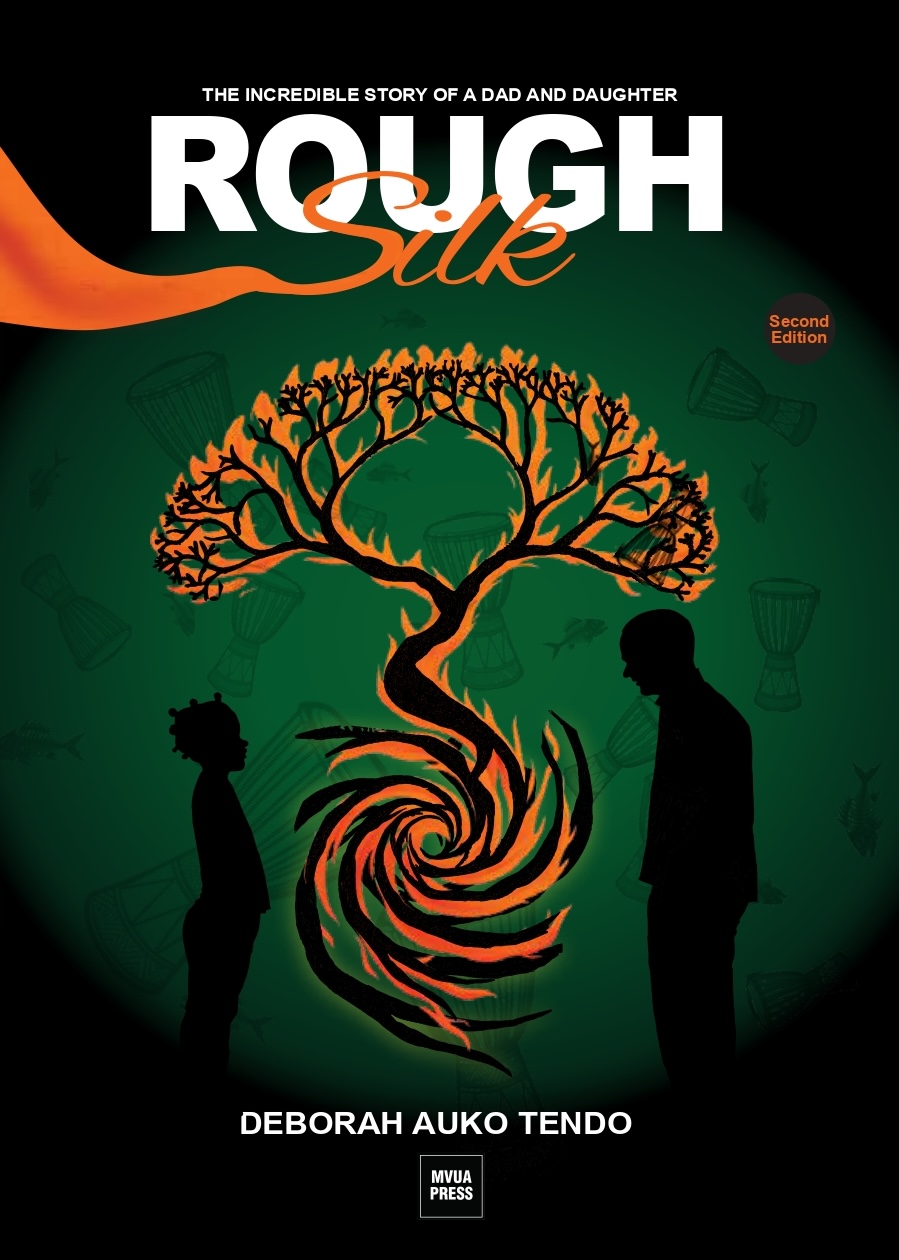
TITLE: Rough Silk
AUTHOR: Deborah Tendo Auko
PUBLISHER: Mvua Press
REVIEWER: Tracy M. Ochieng
AVAILABILITY: shop.eKitabu.com
PRICE: Ksh1,500
As a child, I would notice in neighbours’ houses inscriptions such as ‘Christ is the head of this house’ or ‘Go placidly with Jesus.’ In our house, it was Go placidly with Raila Amolo Odinga,’” writes Deborah Tendo in her debut memoir, Rough Silk. For many children raised in Luo households, this was not unusual. Before God, there was Raila Amolo Odinga, son of Kenya’s enigmatic former Vice President, Jaramogi Oginga Odinga. His presence was not merely political; it was devotional.
If there was any surface to claim, and there always was, it bore his image. I remember our refrigerator, long retired from service due to relentless power rationing in Mathare, repurposed into storage and memory. Its metal body became a shrine, layered with stickers of Raila and the Orange Democratic Movement. Time itself seemed to pause whenever he appeared on television or the radio. For many of us, Raila was not just a leader; he was a kind of god.
Reading Rough Silk stirred these memories with startling clarity. But Deborah Tendo’s memoir is not, at its core, about Raila. It is about something far more intimate, and perhaps more unsettling: How do we learn to deify the men in our lives?
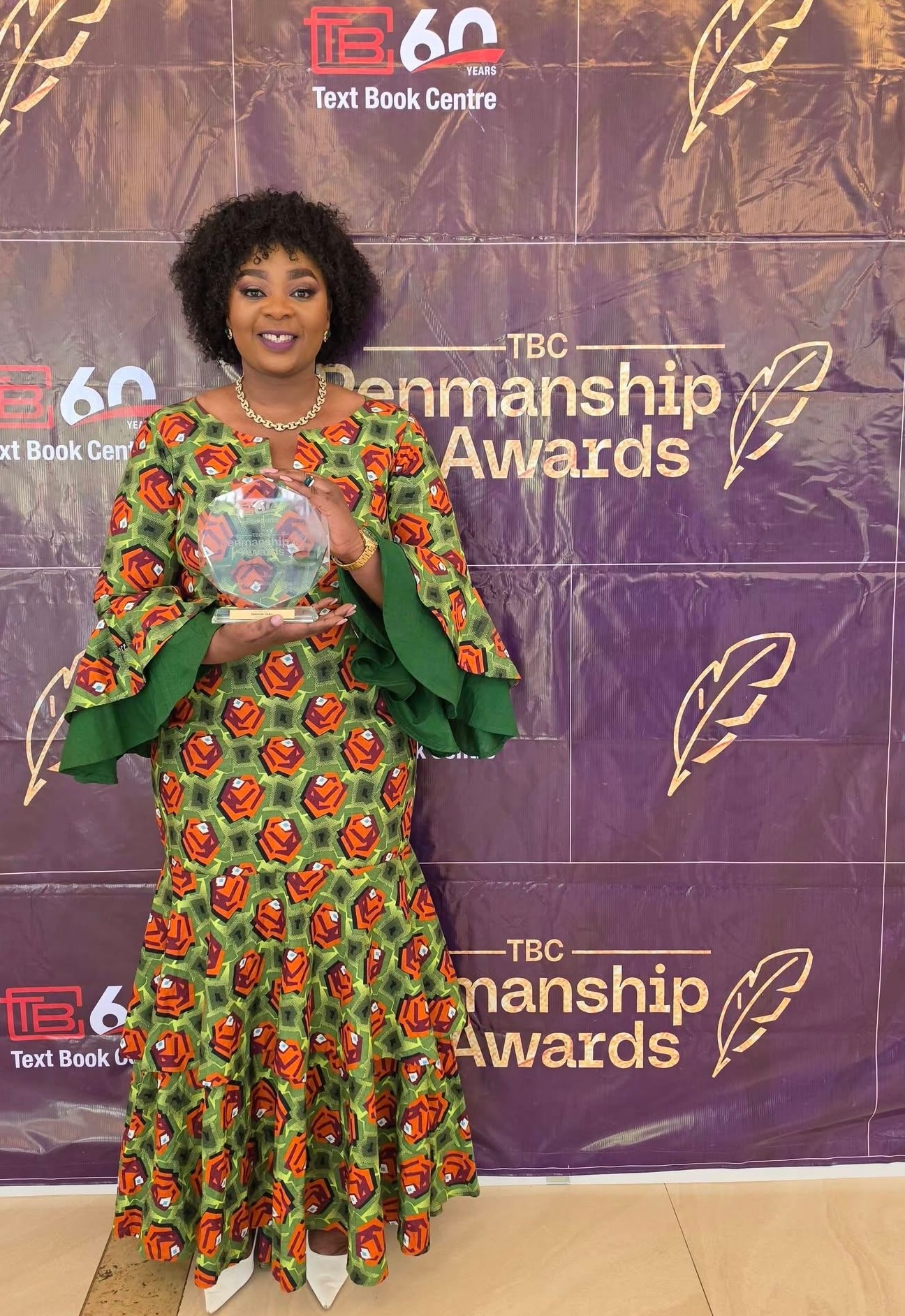
It is perhaps unsurprising, then, that the memoir won the first runners-up by the Text Book Centre’s Penmanship Award in the adult category, a prize that celebrates emerging Kenyan writing with originality, emotional depth, and literary promise. Tendo’s work carries all three with remarkable ease.
Spanning 69 years, Rough Silk traces the life of George Auko—a man whose very birth feels steeped in myth. When Achieng Nyongalo gives birth beneath the Otho tree, her blood feeding into the soil as she takes her last breath, Auko’s life begins as hers ends. It is a moment that feels less like coincidence and more like design—an intervention of Juok, the unseen hand that shapes destiny in Luo cosmology.
From the very beginning, Auko is marked by something larger than himself. And yet, as Tendo reveals, what follows is not the life of a god, but of a deeply human male– flawed, charismatic, loving, and at times, painfully contradictory. Unlike most men who lived by the lakeside who depended on fishing as their livelihood in the 70s, Auko settled for the fast-paced city of Nairobi at 23, leaving his two wives and children behind.
In Nairobi, Auko becomes a man untethered from the expectations of home. The city offers him not just opportunity, but reinvention– wild parties, great rumba music and politics. It is here, in the rhythm of rumba and the intoxication of nightlife, that he encounters Pamela Odede, Tendo’s mother. Described as a very good-looking man with a lighter complexion–because apparently dark skin has become stereotypically synonymous with people from the lake– Auko would have mothers proposition their daughters to him. That’s how he got Nyasamia, his Mikayi and Nyakendu as his second wife.
The meeting between Auko and Pamela feels almost inevitable and is one that would set the course for Tendo’s life story. Auko, already a husband and father, does not arrive in Nairobi as a free man, yet he moves as though he is one. When confronted with the truth of his past, he does not negotiate with it; he erases it. In marrying Pamela, he does not simply choose love; he chooses the version of himself he wishes to be. It is this tension between who Auko is and who he insists on becoming that gives Rough Silk its emotional texture. He is a man in pursuit of love, yet incapable of holding it without fracture, presenting him as a figure that’s both magnetic and destabilising.
Polygamy
Polygamy, in the Kenyan context, has long been the subject of moral and cultural debate, particularly among Christian communities, where it is often framed in opposition to monogamous ideals, and in contrast to Islamic traditions, where it is more formally structured and accepted. One of the most enduring justifications for the practice is rooted in provision: that polygamy ensured no woman was left unmarried, and therefore, uncared for.
Rough Silk situates Auko within this cultural logic, one where men are understood as providers and women as dependents. It is a familiar argument, one that has been repeated so often it risks passing as fact. But here, the memoir provokes a question the text itself does not explicitly ask: If women were the ones tilling the land (from seed preparation to harvest), who, in reality, was doing the providing?
Following his separation from Pamela, Auko subsequently marries five more women, and what emerges is not the stability that polygamy promises in theory, but a life marked by financial strain, emotional fragmentation, and, at times, domestic violence. Tendo does not interrogate this system directly; instead, she writes from within it, rendering her father with a tenderness that neither denies his failures nor fully dismantles the structures that made them possible.
Badly behaved women of Literature
There is a particular kind of silence that follows abandonment. It is not loud, not always visible, but it settles quietly into the lives of children, shaping how they understand love, absence, and themselves. To be left behind is, in many ways, to grieve someone who is still alive.
In many societies, the figure of the absent father has, over time, been normalised and explained away through language that softens his departure. Men leave, wander and need to build themselves first and yet, life continues around that absence, often carried by women who remain. But when a woman leaves, the rupture is different. It is sharper, less forgivable and unsettles something deeply held about care, duty, and what a mother is supposed to be. A woman who leaves is rarely afforded complexity but is instead cast in the language of failure.
When Pamela discovers her husband half-naked in her brother’s house after a night of debauchery, the moment collapses whatever remains of their domestic world. She leaves abruptly, perhaps necessarily, but in doing so, she also leaves Tendo and her brother Philip behind to bear witness to a scene no child should have to interpret. That moment becomes a fracture line. It is not simply that Pamela leaves; it is how she leaves, and what remains in her absence. For Tendo, this would be the last time she encountered her mother within the structure of the family.
To sit with Pamela’s departure is not to excuse it, nor to condemn it outright. It is to ask more difficult questions: What breaks a woman to the point of leaving? What does it mean to choose oneself in a world that has taught women to endure? And who carries the cost of that choice?
The stories of single motherhood are often told in the language of lack: of what is missing, what has failed, what could not be held together. A single mother is too easily read as evidence of something gone wrong, her life framed as a cautionary tale rather than a site of endurance, labour, and care. Single fathers, on the other hand, are frequently narrated with a kind of reverence. Their presence is seen as exceptional, their effort amplified, their care interpreted as a quiet heroism. Where the single mother is scrutinised, the single father is often celebrated.
This is not to diminish the reality of single fatherhood, nor the labour it demands. Rather, it is to observe how differently care is valued depending on who performs it. When a man stays, he is seen as exceeding expectations. When a woman stays, she is simply doing what she was always meant to do.
And then there is Mama Mpenzi, another bad girl like Kenyan legislator Millie Odhiambo’sbad girl in literature.
Mama Mpenzi was the type of woman who would smoke cigarettes in public and, to provoke even more outrage, as Tendo recalls, she would smoke two at once, one on either side of her mouth. It is an image that lingers not because of its excess, but because of what it disrupts. Mama Mpenzi refuses to be contained within the quiet, respectable boundaries expected of women. She takes up space visibly and unapologetically.
She is unmistakably a girl’s girl. Not in the softened, aesthetic sense the phrase has come to carry, but in its more urgent, embodied form. In moments of confrontation, she stands with Pamela, even engaging Auko in public brawls following the turbulent end of her marriage. Acts that, while unsettling, signal a refusal to remain silent in the face of betrayal. (Violence, of course, is never a solution, but neither is erasure.)
When her husband takes a second wife, Mama Mpenzi does not retreat into quiet suffering. Instead, she turns outward and claims a different kind of life that is shaped by her own labour and will, starting a hairdressing business that becomes both livelihood and declaration. In a context where endurance is often mistaken for virtue, her actions read as disruption. It is here that the question of the “bad woman” in literature becomes necessary. Women like Mama Mpenzi are not written to be easily loved. They are excessive, loud, and sometimes contradictory, but they unsettle the moral frameworks we have inherited about what a woman should be–nurturing, patient, forgiving, contained.
For young women encountering such characters, these figures offer something rare–alternative scripts for womanhood. Not all of these scripts are comfortable. Some are flawed, even troubling, but they expand the imagination. They suggest that a woman might refuse, might rage, might choose herself, might build something from the fragments of a life that did not hold.
To read Mama Mpenzi is not to aspire to her in totality. It is to recognise the possibility of deviation. Because literature that only gives us “good” women and it rarely has, or at least it paints them as cautionary tales—obedient, enduring, endlessly forgiving—leaves little room for the full spectrum of female experience. It denies the reality that women, like all people, are capable of contradiction, of mess, of reinvention. The so-called “bad girls” of literature do fracture the singular story. They remind us that womanhood is not a fixed performance, but a shifting, often contested space. And for the young woman reading, perhaps quietly, perhaps searching for language for her own unrest, that fracture can feel like permission.
Tracy Ochieng is a staff writer with Books in Africa. Email: tracy.ochieng@ekitabu.com

Related Book
Get to know more about the mentioned books
Related Article
Hints of Baba: Tendo’s ‘Rough Silk’ wins TBC runners-up award
By
TITLE: Rough Silk
AUTHOR: Deborah Tendo Auko
PUBLISHER: Mvua Press
REVIEWER: Tracy M. Ochieng
AVAILABILITY: shop.eKitabu.com
PRICE: Ksh1,500
As a child, I would notice in neighbours’ houses inscriptions such as ‘Christ is the head of this house’ or ‘Go placidly with Jesus.’ In our house, it was Go placidly with Raila Amolo Odinga,’” writes Deborah Tendo in her debut memoir, Rough Silk. For many children raised in Luo households, this was not unusual. Before God, there was Raila Amolo Odinga, son of Kenya’s enigmatic former Vice President, Jaramogi Oginga Odinga. His presence was not merely political; it was devotional.
If there was any surface to claim, and there always was, it bore his image. I remember our refrigerator, long retired from service due to relentless power rationing in Mathare, repurposed into storage and memory. Its metal body became a shrine, layered with stickers of Raila and the Orange Democratic Movement. Time itself seemed to pause whenever he appeared on television or the radio. For many of us, Raila was not just a leader; he was a kind of god.
Reading Rough Silk stirred these memories with startling clarity. But Deborah Tendo’s memoir is not, at its core, about Raila. It is about something far more intimate, and perhaps more unsettling: How do we learn to deify the men in our lives?
It is perhaps unsurprising, then, that the memoir won the first runners-up by the Text Book Centre’s Penmanship Award in the adult category, a prize that celebrates emerging Kenyan writing with originality, emotional depth, and literary promise. Tendo’s work carries all three with remarkable ease.
Spanning 69 years, Rough Silk traces the life of George Auko—a man whose very birth feels steeped in myth. When Achieng Nyongalo gives birth beneath the Otho tree, her blood feeding into the soil as she takes her last breath, Auko’s life begins as hers ends. It is a moment that feels less like coincidence and more like design—an intervention of Juok, the unseen hand that shapes destiny in Luo cosmology.
From the very beginning, Auko is marked by something larger than himself. And yet, as Tendo reveals, what follows is not the life of a god, but of a deeply human male– flawed, charismatic, loving, and at times, painfully contradictory. Unlike most men who lived by the lakeside who depended on fishing as their livelihood in the 70s, Auko settled for the fast-paced city of Nairobi at 23, leaving his two wives and children behind.
In Nairobi, Auko becomes a man untethered from the expectations of home. The city offers him not just opportunity, but reinvention– wild parties, great rumba music and politics. It is here, in the rhythm of rumba and the intoxication of nightlife, that he encounters Pamela Odede, Tendo’s mother. Described as a very good-looking man with a lighter complexion–because apparently dark skin has become stereotypically synonymous with people from the lake– Auko would have mothers proposition their daughters to him. That’s how he got Nyasamia, his Mikayi and Nyakendu as his second wife.
The meeting between Auko and Pamela feels almost inevitable and is one that would set the course for Tendo’s life story. Auko, already a husband and father, does not arrive in Nairobi as a free man, yet he moves as though he is one. When confronted with the truth of his past, he does not negotiate with it; he erases it. In marrying Pamela, he does not simply choose love; he chooses the version of himself he wishes to be. It is this tension between who Auko is and who he insists on becoming that gives Rough Silk its emotional texture. He is a man in pursuit of love, yet incapable of holding it without fracture, presenting him as a figure that’s both magnetic and destabilising.
Polygamy
Polygamy, in the Kenyan context, has long been the subject of moral and cultural debate, particularly among Christian communities, where it is often framed in opposition to monogamous ideals, and in contrast to Islamic traditions, where it is more formally structured and accepted. One of the most enduring justifications for the practice is rooted in provision: that polygamy ensured no woman was left unmarried, and therefore, uncared for.
Rough Silk situates Auko within this cultural logic, one where men are understood as providers and women as dependents. It is a familiar argument, one that has been repeated so often it risks passing as fact. But here, the memoir provokes a question the text itself does not explicitly ask: If women were the ones tilling the land (from seed preparation to harvest), who, in reality, was doing the providing?
Following his separation from Pamela, Auko subsequently marries five more women, and what emerges is not the stability that polygamy promises in theory, but a life marked by financial strain, emotional fragmentation, and, at times, domestic violence. Tendo does not interrogate this system directly; instead, she writes from within it, rendering her father with a tenderness that neither denies his failures nor fully dismantles the structures that made them possible.
Badly behaved women of Literature
There is a particular kind of silence that follows abandonment. It is not loud, not always visible, but it settles quietly into the lives of children, shaping how they understand love, absence, and themselves. To be left behind is, in many ways, to grieve someone who is still alive.
In many societies, the figure of the absent father has, over time, been normalised and explained away through language that softens his departure. Men leave, wander and need to build themselves first and yet, life continues around that absence, often carried by women who remain. But when a woman leaves, the rupture is different. It is sharper, less forgivable and unsettles something deeply held about care, duty, and what a mother is supposed to be. A woman who leaves is rarely afforded complexity but is instead cast in the language of failure.
When Pamela discovers her husband half-naked in her brother’s house after a night of debauchery, the moment collapses whatever remains of their domestic world. She leaves abruptly, perhaps necessarily, but in doing so, she also leaves Tendo and her brother Philip behind to bear witness to a scene no child should have to interpret. That moment becomes a fracture line. It is not simply that Pamela leaves; it is how she leaves, and what remains in her absence. For Tendo, this would be the last time she encountered her mother within the structure of the family.
To sit with Pamela’s departure is not to excuse it, nor to condemn it outright. It is to ask more difficult questions: What breaks a woman to the point of leaving? What does it mean to choose oneself in a world that has taught women to endure? And who carries the cost of that choice?
The stories of single motherhood are often told in the language of lack: of what is missing, what has failed, what could not be held together. A single mother is too easily read as evidence of something gone wrong, her life framed as a cautionary tale rather than a site of endurance, labour, and care. Single fathers, on the other hand, are frequently narrated with a kind of reverence. Their presence is seen as exceptional, their effort amplified, their care interpreted as a quiet heroism. Where the single mother is scrutinised, the single father is often celebrated.
This is not to diminish the reality of single fatherhood, nor the labour it demands. Rather, it is to observe how differently care is valued depending on who performs it. When a man stays, he is seen as exceeding expectations. When a woman stays, she is simply doing what she was always meant to do.
And then there is Mama Mpenzi, another bad girl like Kenyan legislator Millie Odhiambo’sbad girl in literature.
Mama Mpenzi was the type of woman who would smoke cigarettes in public and, to provoke even more outrage, as Tendo recalls, she would smoke two at once, one on either side of her mouth. It is an image that lingers not because of its excess, but because of what it disrupts. Mama Mpenzi refuses to be contained within the quiet, respectable boundaries expected of women. She takes up space visibly and unapologetically.
She is unmistakably a girl’s girl. Not in the softened, aesthetic sense the phrase has come to carry, but in its more urgent, embodied form. In moments of confrontation, she stands with Pamela, even engaging Auko in public brawls following the turbulent end of her marriage. Acts that, while unsettling, signal a refusal to remain silent in the face of betrayal. (Violence, of course, is never a solution, but neither is erasure.)
When her husband takes a second wife, Mama Mpenzi does not retreat into quiet suffering. Instead, she turns outward and claims a different kind of life that is shaped by her own labour and will, starting a hairdressing business that becomes both livelihood and declaration. In a context where endurance is often mistaken for virtue, her actions read as disruption. It is here that the question of the “bad woman” in literature becomes necessary. Women like Mama Mpenzi are not written to be easily loved. They are excessive, loud, and sometimes contradictory, but they unsettle the moral frameworks we have inherited about what a woman should be–nurturing, patient, forgiving, contained.
For young women encountering such characters, these figures offer something rare–alternative scripts for womanhood. Not all of these scripts are comfortable. Some are flawed, even troubling, but they expand the imagination. They suggest that a woman might refuse, might rage, might choose herself, might build something from the fragments of a life that did not hold.
To read Mama Mpenzi is not to aspire to her in totality. It is to recognise the possibility of deviation. Because literature that only gives us “good” women and it rarely has, or at least it paints them as cautionary tales—obedient, enduring, endlessly forgiving—leaves little room for the full spectrum of female experience. It denies the reality that women, like all people, are capable of contradiction, of mess, of reinvention. The so-called “bad girls” of literature do fracture the singular story. They remind us that womanhood is not a fixed performance, but a shifting, often contested space. And for the young woman reading, perhaps quietly, perhaps searching for language for her own unrest, that fracture can feel like permission.
Tracy Ochieng is a staff writer with Books in Africa. Email: tracy.ochieng@ekitabu.com
Share :


Lorem ipsum dolor sit amet, consectetur adipiscing elit. Suspendisse varius enim in eros elementum tristique. Duis cursus, mi quis viverra ornare, eros dolor interdum nulla, ut commodo diam libero vitae erat. Aenean faucibus nibh et justo cursus id rutrum lorem imperdiet. Nunc ut sem vitae risus tristique posuere.
Lorem ipsum dolor sit amet, consectetur adipiscing elit. Suspendisse varius enim in eros elementum tristique. Duis cursus, mi quis viverra ornare, eros dolor interdum nulla, ut commodo diam libero vitae erat. Aenean faucibus nibh et justo cursus id rutrum lorem imperdiet. Nunc ut sem vitae risus tristique posuere.