
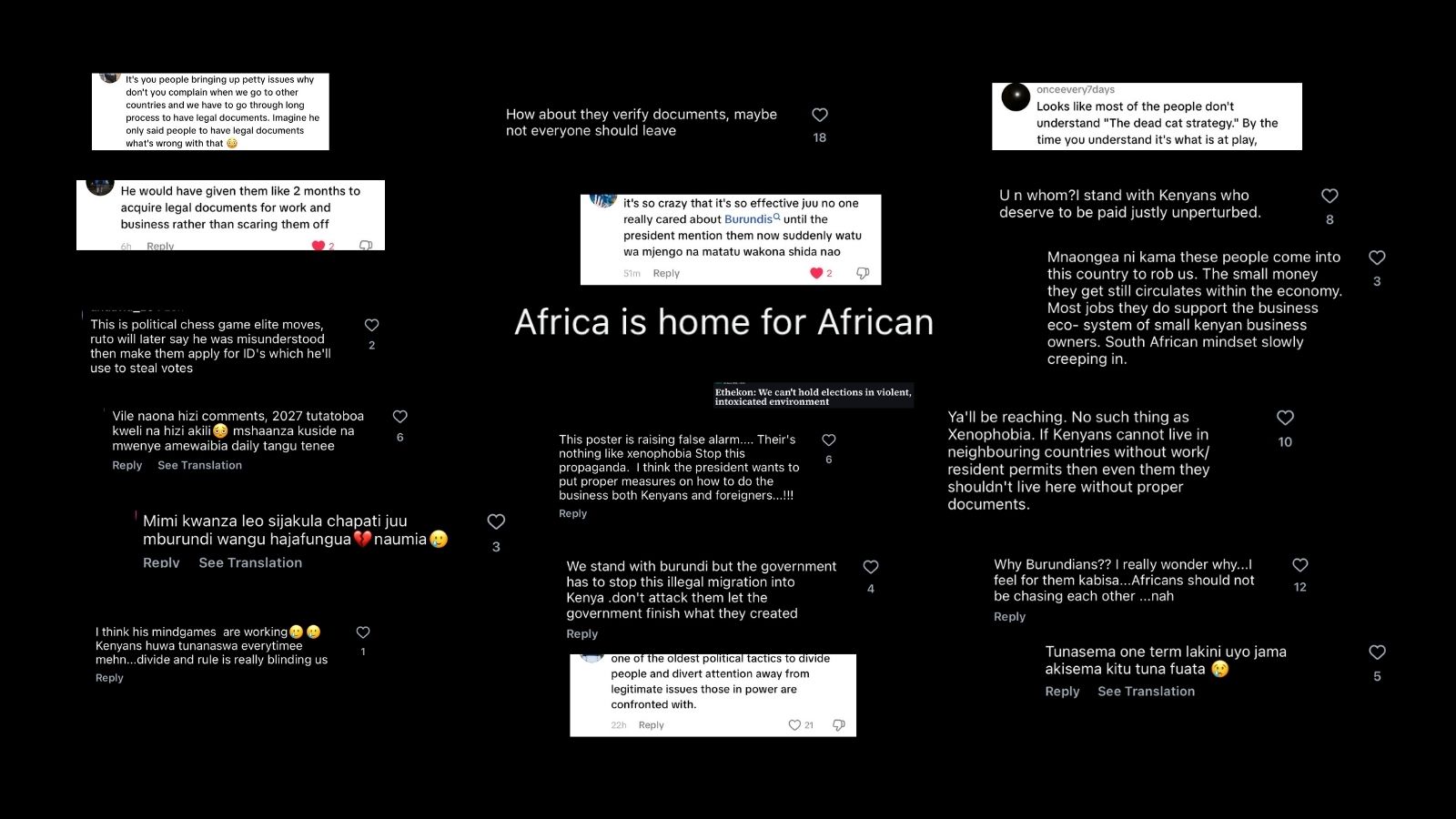

Race and class feature prominently as Kenyan President issues directive that spawns confusion, xenophobic attacks
You can fool some people some of the time, but you can't fool all the people all the time
A few months ago, I got myself into trouble for saying something that, at the time, seemed rather obvious to me: racism against Africans in other parts of the world will continue to matter, but it will not be the only battle we have to fight.
There is something tragic about demanding that the rest of the world value African lives when Africans themselves have become increasingly comfortable deciding which Africans are worthy of belonging. That’s why you will see African politicians crying on TV day in and day out, “Oh, we are asking the international community to intervene…” whenever there is violence or injustice on the continent. But at what point do we ask why our own systems of accountability have failed us so completely? Why must someone from outside Africa intervene before African lives become worthy of protection? We are so quick to ask the world to save us from ourselves, yet we continue to find new ways of failing one another.
It is the same uncomfortable contradiction that is encountered when discussing patriarchy because a system does not survive only because those at the top enforce it. It survives because its ideas can become so deeply embedded that people within the very communities it disadvantages sometimes reproduce them. And this is where Kenya finds itself today.
This time, the target is the African migrant.
On 2 September, President William Ruto met representatives of Kenya's micro, small and medium enterprises at State House. Among the issues raised by traders was competition from foreign nationals engaged in small-scale trade, and one of the complaints was particularly revealing.
Businesswoman Damaris Wanjiru Muriithi, popularly known as Dama Wa Spares, raised concerns about Chinese traders who, according to reports, were importing or selling goods at prices that Kenyan retailers struggled to match. Her argument was straightforward: why should a Kenyan trader source goods from a foreign wholesaler, incur the costs of getting those goods to market and then sell them at a retail price, only for the same foreign trader to enter the Kenyan market and sell directly to consumers at something closer to wholesale prices? That is a legitimate economic question.
The government has a responsibility to examine whether foreign businesses are complying with immigration, work permit, licensing and tax requirements. It has a responsibility to ensure that Kenyan traders are not competing against businesses operating outside the law. But then President Ruto made a much broader intervention, directing that foreign nationals engaged in hawking and other small-scale businesses should stop, arguing that the government needed to protect Kenyan traders from unfair competition. And suddenly, the question became much bigger than Chinese traders. Why did a complaint that specifically mentioned Chinese traders become, within days, a crisis in which Burundians appeared to have become the target?
Let’s be clear, Chinese traders have not been completely untouched by the fallout. On 8 September, police reported that four people had been arrested over alleged harassment and extortion of Chinese traders in Nyamakima, where a group was reportedly demanding to inspect immigration and business documents and allegedly asking for money.
But look at the images that have dominated this story.
Hundreds of Burundian nationals flocked to their embassy in Nairobi seeking travel documents. Some feared they would be forced to leave. Others said they had received threats or have faced harassment. Some were preparing to return home despite a new government assurance that undocumented East Africans would be given time to regularise their status. That distinction matters. Because if the problem is illegal or unlicensed foreign businesses, then the law should determine who is targeted. Not nationality. Not how poor someone looks. Not how politically powerless their community is. Not whether they have the economic clout to push back.
The foreigner at the bottom
This is where class enters the conversation with a question that seems to be missing from the conversation: Who exactly are we protecting, and from whom? Because, as always, it appears to be the people at the bottom who are being asked to fight one another over the scraps. Do we honestly believe that the Kenyan mother featured on television crying because she cannot find work for her grown ‘child’ is the real beneficiary of this fight? And who exactly is the Burundian she is being encouraged to see as her economic competitor? It is definitely not the Burundian living and running a business in Kilimani or Westlands.
Nobody appears to be marching into affluent neighbourhoods asking whether the foreign professionals, investors, consultants and executives living there have displaced Kenyans from economic opportunities. The scrutiny seems to become particularly intense when the foreigner is selling second-hand clothes, doing domestic work, carrying goods, working on a construction site or running a small shop. Because xenophobia, like many other forms of discrimination, has a class dimension. The foreigner at the bottom is more visible. He sells to us, cleans, builds for us, competes with us for casual work and lives in our estates and markets. The foreigner at the top is more likely to be called an ‘expatriate '.
And then there is the question of Somalis.
Why does this logic seem to become more complicated when we talk about Somali Kenyans and Somali migrants who have built one of Nairobi's most significant commercial centres in Eastleigh? For years, Eastleigh has been described—sometimes admiringly, sometimes resentfully—as a kind of Somali economic enclave. It is one of the most commercially vibrant parts of Nairobi, built around a community that has accumulated significant economic and political power. There is, however, a curious duality in the way Kenya relates to this community: there is fear, resentment, but also a degree of reverence. The same society that can casually speak about foreigners “taking our jobs” also shops in Eastleigh, sources goods from Eastleigh and celebrates the entrepreneurial success of its Somali business community.
So what and who determines when an immigrant community becomes a threat and when it becomes an economic success story? Is it simply numbers? Is it wealth? Is it political influence? Or, more uncomfortably, is it our perception of who has the power to push back?
Perhaps this is where J.M. Kariuki's famous warning from 1974 becomes relevant again. He described Kenya as “a nation of ten millionaires and ten million beggars” and more than five decades later, the language may have changed, but the anxiety has not.
We are still a country in which wealth and opportunity are extraordinarily unevenly distributed. We are still a country where millions of people can feel economically abandoned while a much smaller group accumulates extraordinary wealth, and perhaps that is why scapegoating is so politically useful.
When people are struggling to pay rent, find work, feed their children or keep a small business afloat, it is much easier to point to the person next to them than to interrogate the structures above them.
It is easier to say:
The Burundians are taking our jobs.
The Somalis have taken Eastleigh.
The Chinese are taking our businesses.
The Indians control everything.
The West is exploiting us.
The foreigners are the problem.
There may be uncomfortable truths contained within some of these complaints. But there is a danger in making the foreigner the explanation for every economic failure. Because eventually we stop asking who created the conditions in which millions of people are fighting over informal work in the first place.
There is something almost theatrical about creating or presiding over conditions that produce public anger and then appearing before that same public to announce that you have identified the culprit.
First, people are desperate. Then they are angry. Then someone tells them who is responsible. Then the government arrives with the solution. It is an old political trick: create a problem, identify an enemy and then present yourself as the person capable of solving it.
I am deliberately framing this as a question rather than an accusation, because I do not know what happens inside government meetings and I have no evidence that this particular crackdown was conceived as some psychological experiment. But I cannot help wondering about the political usefulness of it. What happens when a government tests how easily economic frustration can be redirected towards an identifiable group? What happens when people who should be asking why their economy is failing instead begin asking why another African is allowed to sell goods on the same street? What happens when a population is so economically exhausted that all it needs is a target?
Those questions matter in Kenya because we have been here before: 2007 and 2008.
Not because the present situation is identical to the post-election violence. It is not. The circumstances are different, and we should be careful not to manufacture parallels where they do not exist. But Kenya has already witnessed what happens when political and economic grievances are reduced to battles between communities; when fear becomes contagious; when rumours travel faster than facts; when ordinary people begin to see their neighbours not as fellow citizens but as threats. That history should make us extraordinarily cautious about rhetoric that turns economic desperation into hostility towards another group.
Intent matters, but so does impact.
On 8 September, the government announced a 90-day window for foreign traders to regularise their immigration status, work permits, business registration and licences. It also warned Kenyans against harassment and vigilantism.
We have to take seriously the consequences of the words we use, particularly when those words come from people with enormous political power. You cannot tell an economically frustrated population that foreigners are taking the small businesses and jobs meant for them and then act surprised when the people hearing you interpret that as a call to action. And perhaps the strangest part of this entire episode has been watching ordinary Kenyans defend the crackdown as though the government has finally rescued them from the foreigner standing between them and prosperity.
If the problem is that foreigners are doing casual work that Kenyans are supposedly unwilling or unable to get, why not ask the government to create better opportunities for the youth? Why is the answer always to push someone else down? And more importantly, why are we infantilising grown adults? We speak about young Kenyans as though they cannot decide for themselves what work they are willing to do. Perhaps some young people do not want to hawk mandazis. Perhaps some have spent years in school and reasonably expect that their education should lead to something more than walking through traffic carrying a tray of snacks or working at a construction site. Perhaps others simply cannot survive on the income that such work provides. That, in my humble opinion, is the real conversation we should be having.
Not: Why are foreigners doing these jobs?
But: Why are we producing a generation of educated, unemployed young people whose only available opportunities are increasingly precarious informal work?
If a university graduate does not sell mandazis for ten hours a day in Nairobi, that does not necessarily mean he is lazy. It may mean the economy has failed to produce work that matches his skills, aspirations, and the cost of living. And if a Burundian is willing to do that work for whatever it pays, perhaps the question should be why the Kenyan economy has created a situation where two desperate people are being positioned against each other.
Because instead of asking why the bottom is so crowded and why so few people are willing to question the people who design economic policy, control public resources, and decide how opportunities are distributed, we ask who should be removed from it. Instead of expanding the table, we are fighting over who gets a seat. Perhaps that is the most Kenyan form of incompetence of all: we create a problem, blame somebody else for it and then celebrate the person who arrives to solve it. And then we call that empowerment.
Tracy Ochieng is a staff writer with Books in Africa. tracy.ochieng@ekitabu.com.
Featured Book
.jpg)
Related Book
Get to know more about the mentioned books
Related Article
Race and class feature prominently as Kenyan President issues directive that spawns confusion, xenophobic attacks
By
You can fool some people some of the time, but you can't fool all the people all the time
A few months ago, I got myself into trouble for saying something that, at the time, seemed rather obvious to me: racism against Africans in other parts of the world will continue to matter, but it will not be the only battle we have to fight.
There is something tragic about demanding that the rest of the world value African lives when Africans themselves have become increasingly comfortable deciding which Africans are worthy of belonging. That’s why you will see African politicians crying on TV day in and day out, “Oh, we are asking the international community to intervene…” whenever there is violence or injustice on the continent. But at what point do we ask why our own systems of accountability have failed us so completely? Why must someone from outside Africa intervene before African lives become worthy of protection? We are so quick to ask the world to save us from ourselves, yet we continue to find new ways of failing one another.
It is the same uncomfortable contradiction that is encountered when discussing patriarchy because a system does not survive only because those at the top enforce it. It survives because its ideas can become so deeply embedded that people within the very communities it disadvantages sometimes reproduce them. And this is where Kenya finds itself today.
This time, the target is the African migrant.
On 2 September, President William Ruto met representatives of Kenya's micro, small and medium enterprises at State House. Among the issues raised by traders was competition from foreign nationals engaged in small-scale trade, and one of the complaints was particularly revealing.
Businesswoman Damaris Wanjiru Muriithi, popularly known as Dama Wa Spares, raised concerns about Chinese traders who, according to reports, were importing or selling goods at prices that Kenyan retailers struggled to match. Her argument was straightforward: why should a Kenyan trader source goods from a foreign wholesaler, incur the costs of getting those goods to market and then sell them at a retail price, only for the same foreign trader to enter the Kenyan market and sell directly to consumers at something closer to wholesale prices? That is a legitimate economic question.
The government has a responsibility to examine whether foreign businesses are complying with immigration, work permit, licensing and tax requirements. It has a responsibility to ensure that Kenyan traders are not competing against businesses operating outside the law. But then President Ruto made a much broader intervention, directing that foreign nationals engaged in hawking and other small-scale businesses should stop, arguing that the government needed to protect Kenyan traders from unfair competition. And suddenly, the question became much bigger than Chinese traders. Why did a complaint that specifically mentioned Chinese traders become, within days, a crisis in which Burundians appeared to have become the target?
Let’s be clear, Chinese traders have not been completely untouched by the fallout. On 8 September, police reported that four people had been arrested over alleged harassment and extortion of Chinese traders in Nyamakima, where a group was reportedly demanding to inspect immigration and business documents and allegedly asking for money.
But look at the images that have dominated this story.
Hundreds of Burundian nationals flocked to their embassy in Nairobi seeking travel documents. Some feared they would be forced to leave. Others said they had received threats or have faced harassment. Some were preparing to return home despite a new government assurance that undocumented East Africans would be given time to regularise their status. That distinction matters. Because if the problem is illegal or unlicensed foreign businesses, then the law should determine who is targeted. Not nationality. Not how poor someone looks. Not how politically powerless their community is. Not whether they have the economic clout to push back.
The foreigner at the bottom
This is where class enters the conversation with a question that seems to be missing from the conversation: Who exactly are we protecting, and from whom? Because, as always, it appears to be the people at the bottom who are being asked to fight one another over the scraps. Do we honestly believe that the Kenyan mother featured on television crying because she cannot find work for her grown ‘child’ is the real beneficiary of this fight? And who exactly is the Burundian she is being encouraged to see as her economic competitor? It is definitely not the Burundian living and running a business in Kilimani or Westlands.
Nobody appears to be marching into affluent neighbourhoods asking whether the foreign professionals, investors, consultants and executives living there have displaced Kenyans from economic opportunities. The scrutiny seems to become particularly intense when the foreigner is selling second-hand clothes, doing domestic work, carrying goods, working on a construction site or running a small shop. Because xenophobia, like many other forms of discrimination, has a class dimension. The foreigner at the bottom is more visible. He sells to us, cleans, builds for us, competes with us for casual work and lives in our estates and markets. The foreigner at the top is more likely to be called an ‘expatriate '.
And then there is the question of Somalis.
Why does this logic seem to become more complicated when we talk about Somali Kenyans and Somali migrants who have built one of Nairobi's most significant commercial centres in Eastleigh? For years, Eastleigh has been described—sometimes admiringly, sometimes resentfully—as a kind of Somali economic enclave. It is one of the most commercially vibrant parts of Nairobi, built around a community that has accumulated significant economic and political power. There is, however, a curious duality in the way Kenya relates to this community: there is fear, resentment, but also a degree of reverence. The same society that can casually speak about foreigners “taking our jobs” also shops in Eastleigh, sources goods from Eastleigh and celebrates the entrepreneurial success of its Somali business community.
So what and who determines when an immigrant community becomes a threat and when it becomes an economic success story? Is it simply numbers? Is it wealth? Is it political influence? Or, more uncomfortably, is it our perception of who has the power to push back?
Perhaps this is where J.M. Kariuki's famous warning from 1974 becomes relevant again. He described Kenya as “a nation of ten millionaires and ten million beggars” and more than five decades later, the language may have changed, but the anxiety has not.
We are still a country in which wealth and opportunity are extraordinarily unevenly distributed. We are still a country where millions of people can feel economically abandoned while a much smaller group accumulates extraordinary wealth, and perhaps that is why scapegoating is so politically useful.
When people are struggling to pay rent, find work, feed their children or keep a small business afloat, it is much easier to point to the person next to them than to interrogate the structures above them.
It is easier to say:
The Burundians are taking our jobs.
The Somalis have taken Eastleigh.
The Chinese are taking our businesses.
The Indians control everything.
The West is exploiting us.
The foreigners are the problem.
There may be uncomfortable truths contained within some of these complaints. But there is a danger in making the foreigner the explanation for every economic failure. Because eventually we stop asking who created the conditions in which millions of people are fighting over informal work in the first place.
There is something almost theatrical about creating or presiding over conditions that produce public anger and then appearing before that same public to announce that you have identified the culprit.
First, people are desperate. Then they are angry. Then someone tells them who is responsible. Then the government arrives with the solution. It is an old political trick: create a problem, identify an enemy and then present yourself as the person capable of solving it.
I am deliberately framing this as a question rather than an accusation, because I do not know what happens inside government meetings and I have no evidence that this particular crackdown was conceived as some psychological experiment. But I cannot help wondering about the political usefulness of it. What happens when a government tests how easily economic frustration can be redirected towards an identifiable group? What happens when people who should be asking why their economy is failing instead begin asking why another African is allowed to sell goods on the same street? What happens when a population is so economically exhausted that all it needs is a target?
Those questions matter in Kenya because we have been here before: 2007 and 2008.
Not because the present situation is identical to the post-election violence. It is not. The circumstances are different, and we should be careful not to manufacture parallels where they do not exist. But Kenya has already witnessed what happens when political and economic grievances are reduced to battles between communities; when fear becomes contagious; when rumours travel faster than facts; when ordinary people begin to see their neighbours not as fellow citizens but as threats. That history should make us extraordinarily cautious about rhetoric that turns economic desperation into hostility towards another group.
Intent matters, but so does impact.
On 8 September, the government announced a 90-day window for foreign traders to regularise their immigration status, work permits, business registration and licences. It also warned Kenyans against harassment and vigilantism.
We have to take seriously the consequences of the words we use, particularly when those words come from people with enormous political power. You cannot tell an economically frustrated population that foreigners are taking the small businesses and jobs meant for them and then act surprised when the people hearing you interpret that as a call to action. And perhaps the strangest part of this entire episode has been watching ordinary Kenyans defend the crackdown as though the government has finally rescued them from the foreigner standing between them and prosperity.
If the problem is that foreigners are doing casual work that Kenyans are supposedly unwilling or unable to get, why not ask the government to create better opportunities for the youth? Why is the answer always to push someone else down? And more importantly, why are we infantilising grown adults? We speak about young Kenyans as though they cannot decide for themselves what work they are willing to do. Perhaps some young people do not want to hawk mandazis. Perhaps some have spent years in school and reasonably expect that their education should lead to something more than walking through traffic carrying a tray of snacks or working at a construction site. Perhaps others simply cannot survive on the income that such work provides. That, in my humble opinion, is the real conversation we should be having.
Not: Why are foreigners doing these jobs?
But: Why are we producing a generation of educated, unemployed young people whose only available opportunities are increasingly precarious informal work?
If a university graduate does not sell mandazis for ten hours a day in Nairobi, that does not necessarily mean he is lazy. It may mean the economy has failed to produce work that matches his skills, aspirations, and the cost of living. And if a Burundian is willing to do that work for whatever it pays, perhaps the question should be why the Kenyan economy has created a situation where two desperate people are being positioned against each other.
Because instead of asking why the bottom is so crowded and why so few people are willing to question the people who design economic policy, control public resources, and decide how opportunities are distributed, we ask who should be removed from it. Instead of expanding the table, we are fighting over who gets a seat. Perhaps that is the most Kenyan form of incompetence of all: we create a problem, blame somebody else for it and then celebrate the person who arrives to solve it. And then we call that empowerment.
Tracy Ochieng is a staff writer with Books in Africa. tracy.ochieng@ekitabu.com.
Share :


Lorem ipsum dolor sit amet, consectetur adipiscing elit. Suspendisse varius enim in eros elementum tristique. Duis cursus, mi quis viverra ornare, eros dolor interdum nulla, ut commodo diam libero vitae erat. Aenean faucibus nibh et justo cursus id rutrum lorem imperdiet. Nunc ut sem vitae risus tristique posuere.
Lorem ipsum dolor sit amet, consectetur adipiscing elit. Suspendisse varius enim in eros elementum tristique. Duis cursus, mi quis viverra ornare, eros dolor interdum nulla, ut commodo diam libero vitae erat. Aenean faucibus nibh et justo cursus id rutrum lorem imperdiet. Nunc ut sem vitae risus tristique posuere.