

Women are the ones doing the work, so why are they not involved in determining who gets to lead?
Perhaps we have been asking the wrong question about women and leadership. For years, the language has been familiar: women deserve a seat at the table. Women must be given opportunities. Women must be encouraged to lead. But what happens when women are already in the room? What happens when they are doing the work that keeps the institution moving, building the audiences, reporting the stories, editing the copy, finding the sources and carrying the institutional knowledge, yet somehow become less visible when the people who will make the decisions are announced? That is the uncomfortable question raised by Nation Media Group's latest editorial restructuring.
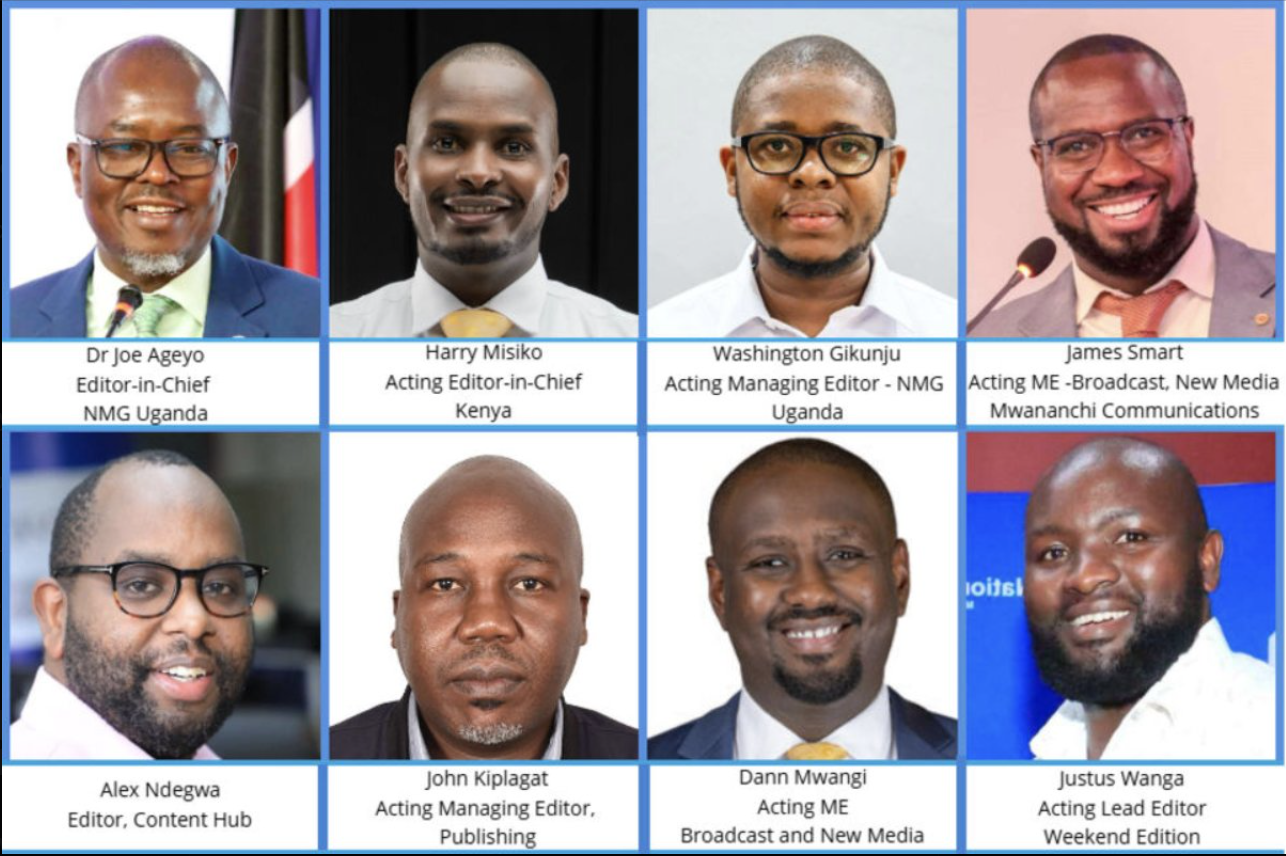
On 16 September, Nation Media Group (NMG) announced changes to its editorial leadership across Kenya, Uganda and Tanzania. In Kenya, Harry Misiko was named Acting Editor-in-Chief, with Dann Mwangi taking on the role of Acting Managing Editor, Broadcast and New Media, and John Kiplagat becoming Acting Managing Editor, Publishing. Other senior editorial appointments announced in Kenya were also …. men. The changes, according to NMG, are part of a restructuring intended to strengthen its editorial operations across a changing media environment.
There is an important distinction here. This is not to suggest that NMG has never placed women in positions of senior authority. It has. The Association of Media Women in Kenya (AMWIK) itself has pointed out that women such as Pamella Sittoni, Wayua Muli, Catherine Gicheru, Dorothy Kweyu and Lucy Oriang o have broken barriers within the organisation. Sittoni also served as a Managing Editor and Executive Editor at NMG and was appointed Public Editor last year.
At Standard Media Group, Esther Kamweru, Lillian Odera, Ellen Wanjiru and Caroline Kimutai served as either managing editors, head of broadcast or even digital editors. Lillian Aluanga and Rasnah Warah also served in senior editorial capacity at the same media house. And perhaps that history makes the latest development more interesting, not less. Because the problem is not simply that there are no women capable of leading newsrooms. It is that the further we move towards the highest levels of decision-making, the narrower women's representation becomes.
The Association of Media Women in Kenya's “2026 State of Women in Media Report” makes this painfully clear. Women constitute more than 40 per cent of Kenya's media workforce, yet they occupy only 3.7 per cent of Managing Editor positions and 2.8 per cent of media ownership positions. The same report found that only 7.4 per cent of women remain in the profession beyond the age of 45. That is not simply a recruitment problem but a pipeline problem.
Women are entering the profession. They are reporting, producing and building careers. And yet, somewhere between becoming a young journalist and becoming one of the people who decide what journalism should look like, many disappear. The question, then, is not simply: Where are the women? It is: What happens to women on the way to leadership?
There is a tendency to treat representation as though it were merely arithmetic. Count the women. Count the men. Compare the numbers. Announce progress.
But leadership is not only about who occupies a chair. It is about who has the authority to decide what deserves attention.
An editor decides which story gets assigned, which investigation gets resources, which voice is considered authoritative, which issue becomes a priority and which story is allowed to shape the public conversation. The people sitting at the top of a newsroom therefore influence much more than the internal structure of an organisation. They influence public opinion. They set the national agenda.
That makes the gender imbalance in leadership consequential.
The Global Media Monitoring Project's 2025 findings show that women accounted for only 23 per cent of people seen, heard or spoken about in news across Africa, below the global figure of 26 per cent. The project also found that women's visibility was particularly low outside areas traditionally associated with women's experiences, while women remained disproportionately represented as subjects of gender-based violence.
The numbers tell a story about visibility, but they also tell a story about authority.
Women can be present in the newsroom and still be underrepresented in the production of public knowledge. They can be journalists without being the people deciding which stories matter. They can be experts without being the people routinely invited to speak as experts. They can make up a substantial portion of the workforce without occupying a proportional share of institutional power.
And this is where something else deserves scrutiny: the way we have come to understand gender itself within newsrooms.
AMWIK rightly notes NMG's establishment of a dedicated Gender Desk as part of the organisation's efforts to cover issues affecting women and marginalised groups. But there is something strange about the fact that gender is so often treated as a specialised area of journalism, almost synonymous with women's affairs.
Gender is not another word for women. It is about the ways in which being a man, a woman or belonging to another gender shapes people's experiences of power, work, family, politics, economics, culture and society. A political story has a gender dimension. So does an economic story. So does education, technology, agriculture, health or sport.
Yet when gender becomes a desk, it becomes possible for the rest of the newsroom to imagine itself as gender-neutral.
The irony is that women are then often expected to carry the responsibility for making journalism more gender-responsive, while the structures determining who leads the newsroom remain largely outside that conversation.
Gender equality cannot be the responsibility of the Gender Desk alone. It has to be an editorial question for the entire newsroom. The same contradiction appears in publishing, although it takes a slightly different form.
African publishing is a field in which women are increasingly visible and influential. UNESCO's 2025 mapping of the African book industry specifically highlights the growing participation of women in the sector and their role in creating platforms through which women can tell their own stories and shape narratives. The report, the first comprehensive mapping of the book industry across all 54 African countries, describes a sector with enormous economic and cultural potential.
Look across contemporary African literary culture and the visibility of women is difficult to miss. Women are publishers, editors, writers, booksellers, literary festival organisers, publicists, cultural producers and critics. They are discovering writers, building independent presses and creating spaces in which African literature can circulate.
In some respects, publishing offers the opposite picture to the newsroom: women appear to be everywhere. But being everywhere is not the same as being powerful. That distinction matters because an industry can depend heavily on women's labour and creativity while still having questions about who controls capital, distribution, institutional strategy and the decisions that determine whose work reaches the largest audiences.
This is why the familiar language of “giving women a seat at the table” increasingly feels inadequate because it suggests that women are waiting outside. Often, they are not. They are already inside the building; they are doing the work. The harder question is whether institutions recognise that work as a form of leadership. Who gets entrusted with important decisions before they have the title? Who is encouraged to imagine themselves as an editor, publisher or executive? Who receives the mentorship that turns competence into authority? Who is given the opportunity to fail publicly and still be considered leadership material? Who is allowed to accumulate the experience that later becomes the requirement for senior positions?
Leadership experience does not simply appear on a CV. Someone has to give it to you. Someone has to trust you with the decision, the assignment, the room, the mistake and, eventually, the title. Writing in My Life on the Road, Gloria Steinem reflected on the cost of this uneven distribution of opportunity, saying she was “angry about the human talent that was lost just because it was born into a female body, and the mediocrity that was rewarded because it was born into a male one.” It is a particularly useful way of thinking about the leadership gap because what is lost is not simply a woman's promotion or a seat at a table. It is the talent an institution may never discover because it did not give that person the opportunity to exercise authority in the first place.
AMWIK's finding that only 7.4 per cent of women remain in the media profession beyond 45 should therefore not be read simply as a statistic about women leaving journalism. It should force the industry to ask what it is losing when experienced women leave with them years of institutional knowledge, professional networks and editorial judgement.
Perhaps the most important question is not whether women are being given enough opportunities. It is whether the opportunities being offered are actually capable of carrying them towards power. Because there is a difference between being invited to participate and being trusted to decide. There is a difference between being the person who executes the work and being the person whose judgement determines what work gets done. And there is a difference between having women in an industry and having women shape the institutions that define that industry.
The media and publishing industries do not have a shortage of women. They have a problem with what happens to women's contributions as it approaches authority. That is a much more difficult problem to solve than adding another woman to a panel or appointing another woman to a committee. It requires institutions to look closely at how leadership is identified, cultivated and rewarded. It requires them to examine the invisible career barriers that appear long before a promotion is ever considered. And it requires us to stop treating women's presence as proof that an institution has solved its gender problem. Perhaps, then, we should retire the question of whether women deserve a seat at the table.
The more useful question is this: If women are already doing so much of the work that keeps the table standing, who gets to decide who sits at it?
Tracy Ochieng is a staff writer with Books in Africa. tracy.ochieng@ekitabu.com
Featured Book

Related Book
Get to know more about the mentioned books
Related Article

Women are the ones doing the work, so why are they not involved in determining who gets to lead?
By
Perhaps we have been asking the wrong question about women and leadership. For years, the language has been familiar: women deserve a seat at the table. Women must be given opportunities. Women must be encouraged to lead. But what happens when women are already in the room? What happens when they are doing the work that keeps the institution moving, building the audiences, reporting the stories, editing the copy, finding the sources and carrying the institutional knowledge, yet somehow become less visible when the people who will make the decisions are announced? That is the uncomfortable question raised by Nation Media Group's latest editorial restructuring.
On 16 September, Nation Media Group (NMG) announced changes to its editorial leadership across Kenya, Uganda and Tanzania. In Kenya, Harry Misiko was named Acting Editor-in-Chief, with Dann Mwangi taking on the role of Acting Managing Editor, Broadcast and New Media, and John Kiplagat becoming Acting Managing Editor, Publishing. Other senior editorial appointments announced in Kenya were also …. men. The changes, according to NMG, are part of a restructuring intended to strengthen its editorial operations across a changing media environment.
There is an important distinction here. This is not to suggest that NMG has never placed women in positions of senior authority. It has. The Association of Media Women in Kenya (AMWIK) itself has pointed out that women such as Pamella Sittoni, Wayua Muli, Catherine Gicheru, Dorothy Kweyu and Lucy Oriang o have broken barriers within the organisation. Sittoni also served as a Managing Editor and Executive Editor at NMG and was appointed Public Editor last year.
At Standard Media Group, Esther Kamweru, Lillian Odera, Ellen Wanjiru and Caroline Kimutai served as either managing editors, head of broadcast or even digital editors. Lillian Aluanga and Rasnah Warah also served in senior editorial capacity at the same media house. And perhaps that history makes the latest development more interesting, not less. Because the problem is not simply that there are no women capable of leading newsrooms. It is that the further we move towards the highest levels of decision-making, the narrower women's representation becomes.
The Association of Media Women in Kenya's “2026 State of Women in Media Report” makes this painfully clear. Women constitute more than 40 per cent of Kenya's media workforce, yet they occupy only 3.7 per cent of Managing Editor positions and 2.8 per cent of media ownership positions. The same report found that only 7.4 per cent of women remain in the profession beyond the age of 45. That is not simply a recruitment problem but a pipeline problem.
Women are entering the profession. They are reporting, producing and building careers. And yet, somewhere between becoming a young journalist and becoming one of the people who decide what journalism should look like, many disappear. The question, then, is not simply: Where are the women? It is: What happens to women on the way to leadership?
There is a tendency to treat representation as though it were merely arithmetic. Count the women. Count the men. Compare the numbers. Announce progress.
But leadership is not only about who occupies a chair. It is about who has the authority to decide what deserves attention.
An editor decides which story gets assigned, which investigation gets resources, which voice is considered authoritative, which issue becomes a priority and which story is allowed to shape the public conversation. The people sitting at the top of a newsroom therefore influence much more than the internal structure of an organisation. They influence public opinion. They set the national agenda.
That makes the gender imbalance in leadership consequential.
The Global Media Monitoring Project's 2025 findings show that women accounted for only 23 per cent of people seen, heard or spoken about in news across Africa, below the global figure of 26 per cent. The project also found that women's visibility was particularly low outside areas traditionally associated with women's experiences, while women remained disproportionately represented as subjects of gender-based violence.
The numbers tell a story about visibility, but they also tell a story about authority.
Women can be present in the newsroom and still be underrepresented in the production of public knowledge. They can be journalists without being the people deciding which stories matter. They can be experts without being the people routinely invited to speak as experts. They can make up a substantial portion of the workforce without occupying a proportional share of institutional power.
And this is where something else deserves scrutiny: the way we have come to understand gender itself within newsrooms.
AMWIK rightly notes NMG's establishment of a dedicated Gender Desk as part of the organisation's efforts to cover issues affecting women and marginalised groups. But there is something strange about the fact that gender is so often treated as a specialised area of journalism, almost synonymous with women's affairs.
Gender is not another word for women. It is about the ways in which being a man, a woman or belonging to another gender shapes people's experiences of power, work, family, politics, economics, culture and society. A political story has a gender dimension. So does an economic story. So does education, technology, agriculture, health or sport.
Yet when gender becomes a desk, it becomes possible for the rest of the newsroom to imagine itself as gender-neutral.
The irony is that women are then often expected to carry the responsibility for making journalism more gender-responsive, while the structures determining who leads the newsroom remain largely outside that conversation.
Gender equality cannot be the responsibility of the Gender Desk alone. It has to be an editorial question for the entire newsroom. The same contradiction appears in publishing, although it takes a slightly different form.
African publishing is a field in which women are increasingly visible and influential. UNESCO's 2025 mapping of the African book industry specifically highlights the growing participation of women in the sector and their role in creating platforms through which women can tell their own stories and shape narratives. The report, the first comprehensive mapping of the book industry across all 54 African countries, describes a sector with enormous economic and cultural potential.
Look across contemporary African literary culture and the visibility of women is difficult to miss. Women are publishers, editors, writers, booksellers, literary festival organisers, publicists, cultural producers and critics. They are discovering writers, building independent presses and creating spaces in which African literature can circulate.
In some respects, publishing offers the opposite picture to the newsroom: women appear to be everywhere. But being everywhere is not the same as being powerful. That distinction matters because an industry can depend heavily on women's labour and creativity while still having questions about who controls capital, distribution, institutional strategy and the decisions that determine whose work reaches the largest audiences.
This is why the familiar language of “giving women a seat at the table” increasingly feels inadequate because it suggests that women are waiting outside. Often, they are not. They are already inside the building; they are doing the work. The harder question is whether institutions recognise that work as a form of leadership. Who gets entrusted with important decisions before they have the title? Who is encouraged to imagine themselves as an editor, publisher or executive? Who receives the mentorship that turns competence into authority? Who is given the opportunity to fail publicly and still be considered leadership material? Who is allowed to accumulate the experience that later becomes the requirement for senior positions?
Leadership experience does not simply appear on a CV. Someone has to give it to you. Someone has to trust you with the decision, the assignment, the room, the mistake and, eventually, the title. Writing in My Life on the Road, Gloria Steinem reflected on the cost of this uneven distribution of opportunity, saying she was “angry about the human talent that was lost just because it was born into a female body, and the mediocrity that was rewarded because it was born into a male one.” It is a particularly useful way of thinking about the leadership gap because what is lost is not simply a woman's promotion or a seat at a table. It is the talent an institution may never discover because it did not give that person the opportunity to exercise authority in the first place.
AMWIK's finding that only 7.4 per cent of women remain in the media profession beyond 45 should therefore not be read simply as a statistic about women leaving journalism. It should force the industry to ask what it is losing when experienced women leave with them years of institutional knowledge, professional networks and editorial judgement.
Perhaps the most important question is not whether women are being given enough opportunities. It is whether the opportunities being offered are actually capable of carrying them towards power. Because there is a difference between being invited to participate and being trusted to decide. There is a difference between being the person who executes the work and being the person whose judgement determines what work gets done. And there is a difference between having women in an industry and having women shape the institutions that define that industry.
The media and publishing industries do not have a shortage of women. They have a problem with what happens to women's contributions as it approaches authority. That is a much more difficult problem to solve than adding another woman to a panel or appointing another woman to a committee. It requires institutions to look closely at how leadership is identified, cultivated and rewarded. It requires them to examine the invisible career barriers that appear long before a promotion is ever considered. And it requires us to stop treating women's presence as proof that an institution has solved its gender problem. Perhaps, then, we should retire the question of whether women deserve a seat at the table.
The more useful question is this: If women are already doing so much of the work that keeps the table standing, who gets to decide who sits at it?
Tracy Ochieng is a staff writer with Books in Africa. tracy.ochieng@ekitabu.com
Share :


Lorem ipsum dolor sit amet, consectetur adipiscing elit. Suspendisse varius enim in eros elementum tristique. Duis cursus, mi quis viverra ornare, eros dolor interdum nulla, ut commodo diam libero vitae erat. Aenean faucibus nibh et justo cursus id rutrum lorem imperdiet. Nunc ut sem vitae risus tristique posuere.
Lorem ipsum dolor sit amet, consectetur adipiscing elit. Suspendisse varius enim in eros elementum tristique. Duis cursus, mi quis viverra ornare, eros dolor interdum nulla, ut commodo diam libero vitae erat. Aenean faucibus nibh et justo cursus id rutrum lorem imperdiet. Nunc ut sem vitae risus tristique posuere.